Standard for Sustainable Rice Cultivation v3.0
Transition to the SRP Standard and SRP Performance Indicators v3.0
About the Revision of the SRP Standard for Sustainable Rice Cultivation and Performance Indicators
The Sustainable Rice Platform has completed the technical revision of the SRP Standard for Sustainable Rice Cultivation Version 2.2, resulting in Version 3.0, which was endorsed by the SRP Board in May 2026. SRP is now preparing the revised Standard and associated Performance Indicators, assurance requirements and implementation resources for publication and transition. This revision is being conducted with reference to the ISEAL Code of Good Practice for Sustainability System, ensuring that our standards remain robust, credible, and aligned with global best practices.
The revision of SRP Standard for Sustainable Rice Cultivation, currently version 2.2 into version 3.0, aims to integrate the latest scientific advancements, address ambiguities, enhance auditability, and strengthen focus on social factors like gender empowerment. It seeks to align with updated regulations, simplify data collection, and provide a modular structure for partners. The revision reflects stakeholder demand for a sustainability standard that supports market-based solutions and informs national policy while addressing global commitments like the UN Sustainable Development Goals.
Objectives:
- Enhance Alignment with Evolving Policies and Regulations: Ensure the standard remains responsive to the changing global policy and regulatory landscape.
- Strengthen Gender and Women’s Empowerment: Expand the standard’s focus to better address gender equality and women’s empowerment in sustainable rice cultivation.
- Incorporate Stakeholder Perspectives: Integrate insights and experiences from all relevant stakeholders to create a more inclusive and representative standard.
- Encourage Broader Stakeholder Engagement: Foster greater participation, acceptance, and recognition of the standard across diverse stakeholder groups.
- Maintain Consistency with SRP Normative Guidance: Ensure the standard aligns with other SRP frameworks for a cohesive approach.
- Facilitate Future Integration of Carbon and Ecosystem Services: Structure the standard to allow flexible integration of future modules, such as carbon benefits and ecosystem services, into the SRP Assurance Scheme.
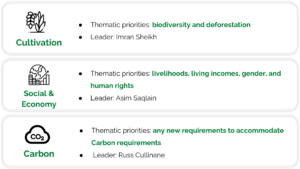
Standard Revision Thematic Focuses
The revision of the SRP Standard is being guided by three dedicated Working Groups (WGs), each focusing on key thematic areas crucial to sustainable rice cultivation. These groups bring together experts, stakeholders, and practitioners from across the rice value chain to ensure a holistic and inclusive revision process.
Standard Revision Progress
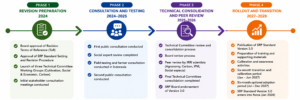
Following endorsement of the SRP Standard for Sustainable Rice Cultivation Version 3.0 by the SRP Board in May 2026, SRP has moved from the technical revision phase into implementation readiness and transition planning.
During this phase, SRP is preparing the supporting framework needed to enable producers, producer groups, auditors, trainers, Conformity Assessment Bodies (CABs), implementing partners and other stakeholders to understand and progressively adopt Version 3.0.
Current activities include:
- finalizing the revised SRP Performance Indicators and associated normative and assurance documents;
- developing implementation guidance, training modules and supporting materials for producers, producer groups, auditors, trainers and other users;
- aligning the SRP Assurance Scheme and verification requirements with the revised Standard;
- preparing auditor, CAB and trainer calibration to support consistent interpretation and implementation;
- updating relevant SRP systems, tools and data requirements to support Version 3.0;
- developing stakeholder communication and awareness materials explaining the main changes and what they mean for different stakeholder groups; and
- preparing the 12-month transition pathway from January to December 2027, ahead of mandatory implementation of Version 3.0 from January 2028.
That last bullet is important. It makes clear that 2027 is not simply a launch date; it is a managed transition year.
Stakeholder Engagement Snapshot
- More than 150 stakeholders and experts engaged throughout the revision process
- 49 participants involved in Working Groups and Technical Committee discussions
- More than 100 public consultation responses received across two consultation rounds
- Field testing and farmer consultations conducted with 3 farmer groups in Indonesia
- Independent peer review conducted by 4 IRRI scientists and experts
SRP would like to express its sincere appreciation to all individuals and organizations who contributed to the revision process, including members of the SRP Board and Technical Committee, Working Group participants, farmers, auditors, researchers, civil society organizations, public sector representatives, private sector actors, external experts, and scientists from the International Rice Research Institute (IRRI). Their technical expertise, practical insights, and constructive feedback played an important role in strengthening the revised Standard and supporting its relevance across diverse rice production contexts.
SRP will continue to share updates as the rollout and transition process progresses.
Planned Rollout and Transition Timeline
- Publication of SRP Standard Version 3.0: January 2027
- Transition and calibration period: January – June 2027
- Optional adoption period: July – December 2027
(producers may choose to apply either SRP Standard Version2.2 or SRP Standard Version3.0 during this period)
- SRP Standard Version 3.0 becomes mandatory for all verification and annual audits: January 2028
SRP Standard Revision Journey (2024 – 2028)
Contact us
For inquiries about the Revision of the SRP Standard for Sustainable Rice Cultivation and Performance Indicators, please reach out to us at assurance@srpglobal.org