Farmers apply climate-smart practices
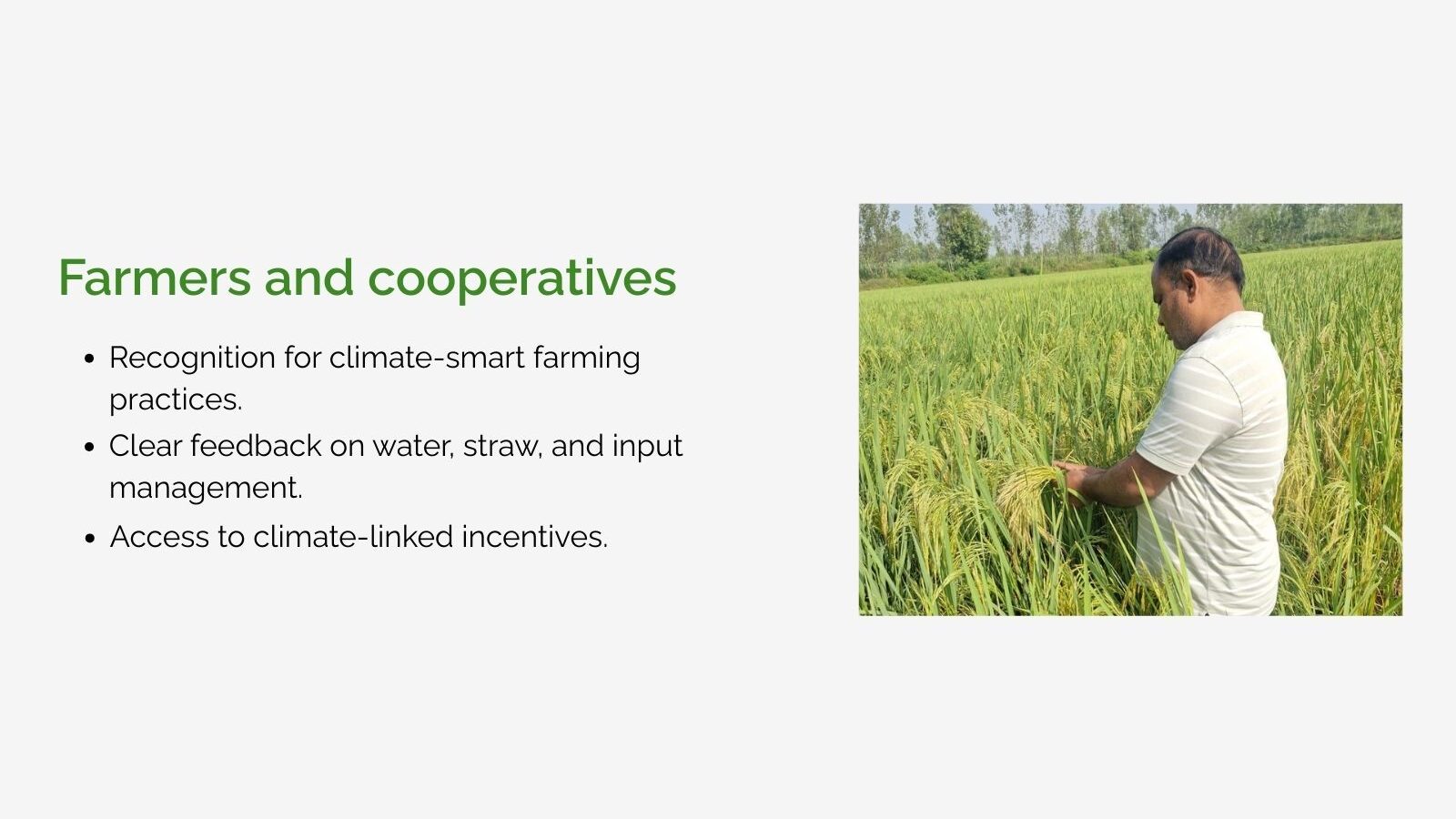
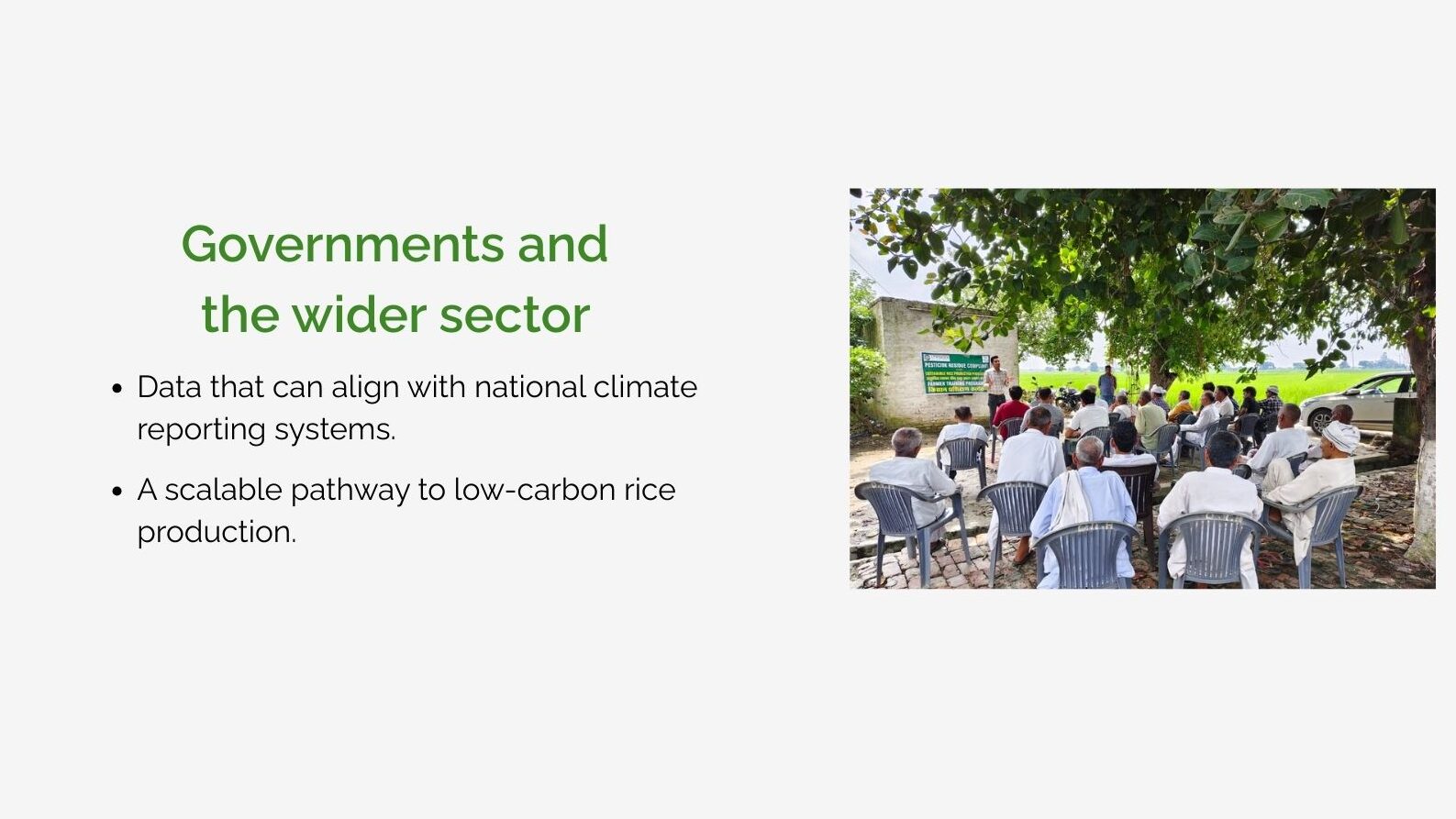
Farmers implement improved water, straw, and crop management practices.
This project was possible thanks to a grant from the ISEAL Innovations Fund, which is supported by the Swiss State Secretariat for Economic Affairs (SECO) and UK International Development from the UK government (Foreign, Commonwealth and Development Office)

Rice cultivation can be a significant source of methane emissions, particularly under prolonged flooding. Facilitated by SRP, the Low-Carbon Assurance Module (L-CAM) is developed to help measure, verify, and communicate greenhouse gas reductions from rice farming in a credible, practical, and scalable way. It links on-farm practices, such as water and straw management, to measurable climate outcomes without creating additional burdens for farmers.
L-CAM follows a clear and practical process:
Farmers implement improved water, straw, and crop management practices.
Simple, auditable data below are collected each season:
Field size, Crop calendar, Water management during the season, Straw management after harvest and Fertilizer use
Remote sensing helps confirm crop cycles, water presence, and straw burning, while farmer records provide detail and context.
L-CAM applies IPCC-consistent Tier 2 approaches where available, uses conservative default parameters where needed, and includes safeguards to prevent over-estimation of climate benefits.
SRP’s assurance system reviews data and calculations to build confidence for buyers and partners.
L-CAM is being rolled out through a phased, learning-by-doing approach. Implementation began with an initial pilot in India, designed to test the module in real-world conditions before replication in other rice-producing countries, including Viet Nam.
India was the first country to implement L-CAM, serving as a practical testing ground for how the module performs across diverse rice-growing contexts. The initial pilot—co-funded by Mars Foods and Nutrition —was deliberately set up to move beyond theory, focusing on how improved rice management practices could be translated into credible, assurance-ready climate data at scale.
Implementation was carried out in close collaboration with value-chain partners LT Foods and Ebro India, ensuring that L-CAM was tested within operational farming and sourcing systems rather than controlled or artificial settings. To support robust measurement, reporting, and verification, Regrow acted as the MRV partner, helping to operationalize data collection and climate performance assessment.
The insights generated in India laid the groundwork for further refinement of the L-CAM approach and informed its replication in other country contexts.




Building on the experience gained in India, Viet Nam is the second country to implement L-CAM, marking a transition from initial piloting to structured replication and refinement. The implementation applies lessons from the India pilot while testing how L-CAM performs in irrigated rice systems, where water management plays a decisive role in methane emissions.
Delivery in Viet Nam is being carried out in collaboration with Lotus Rice as the implementation partner, embedding L-CAM within existing production and sourcing systems. Measurement, reporting, and verification activities are supported by CarbonFarm, strengthening the robustness and coverage of climate data. The initiative is further supported by Rol Ryz, operating within the Euricom Group, reinforcing alignment with commercial value-chain actors.
By moving from pilot testing to scaled application, lessons from Viet Nam will directly inform the evolution of L-CAM and support future implementation across other rice-producing regions.




Please provide the following information to learn more about L-CAM or express interest in future pilots.
Leave your details and our Membership Team will get in touch with you to discuss next steps. For more information about the SRP membership, please also read the SRP Membership Manual Programme.

If you don't have an account yet, please contact us at info@sustainablerice.org.