Farmers apply climate-smart practices
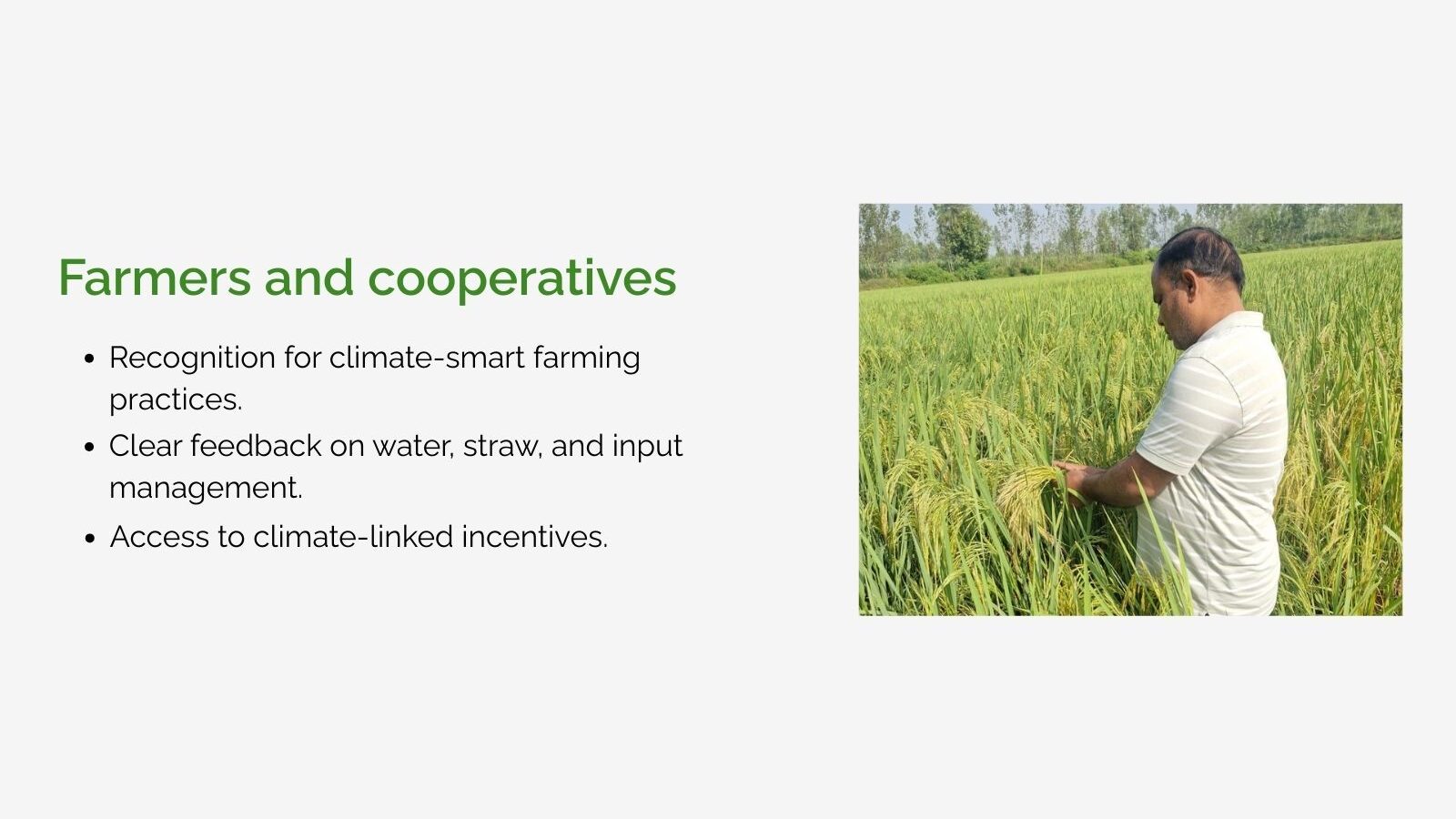
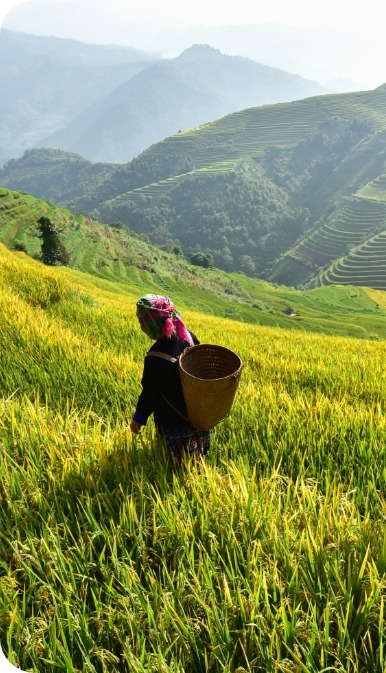
Farmers implement improved water, straw, and crop management practices.
This project was possible thanks to a grant from the ISEAL Innovations Fund, which is supported by the Swiss State Secretariat for Economic Affairs (SECO) and UK International Development from the UK government (Foreign, Commonwealth and Development Office)


Rice cultivation can be a significant source of methane emissions, particularly under prolonged flooding. Facilitated by SRP, the Low-Carbon Assurance Module (L-CAM) is developed to help measure, verify, and communicate greenhouse gas reductions from rice farming in a credible, practical, and scalable way. It links on-farm practices, such as water and straw management, to measurable climate outcomes without creating additional burdens for farmers.
L-CAM follows a clear and practical process:
Farmers implement improved water, straw, and crop management practices.
Simple, auditable data below are collected each season:
Field size, Crop calendar, Water management during the season, Straw management after harvest and Fertilizer use
Remote sensing helps confirm crop cycles, water presence, and straw burning, while farmer records provide detail and context.
L-CAM applies IPCC-consistent Tier 2 approaches where available, uses conservative default parameters where needed, and includes safeguards to prevent over-estimation of climate benefits.
SRP’s assurance system reviews data and calculations to build confidence for buyers and partners.
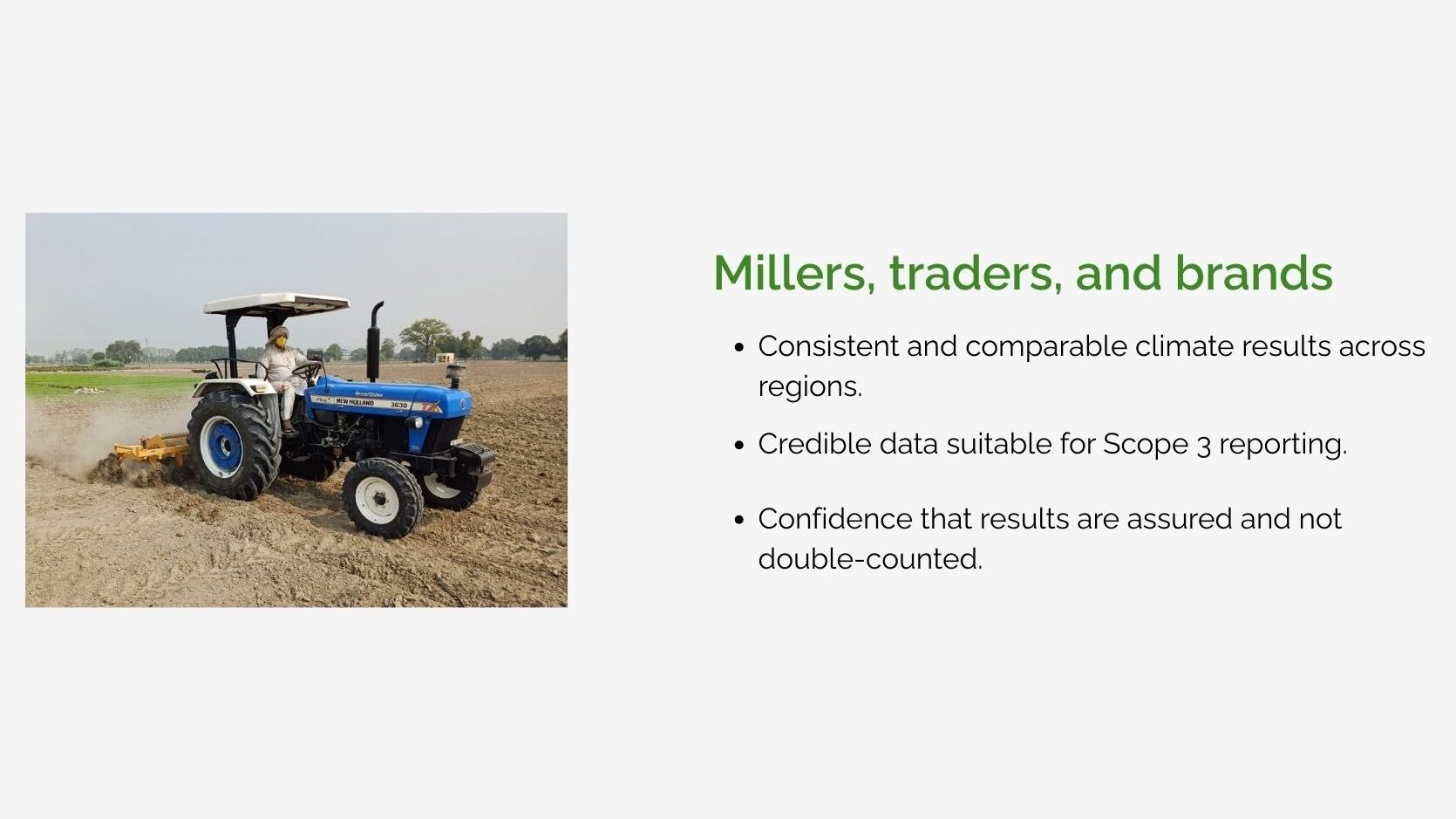
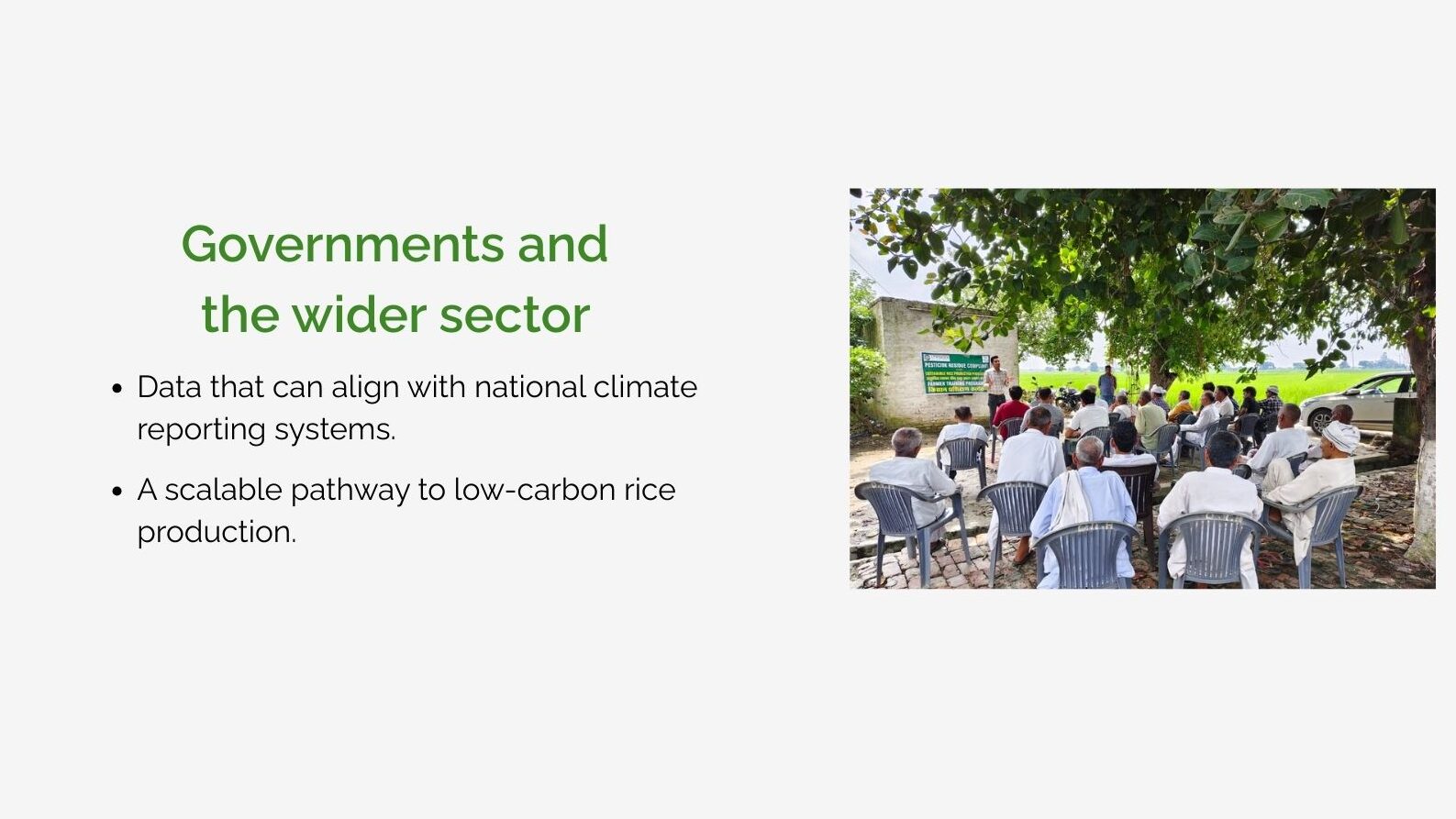
L-CAM is being rolled out through a phased, learning-by-doing approach. Implementation began with an initial pilot in India, designed to test the module in real-world conditions before replication in other rice-producing countries, including Viet Nam.
India was the first country to implement L-CAM, serving as a practical testing ground for how the module performs across diverse rice-growing contexts. The initial pilot—co-funded by Mars Foods and Nutrition —was deliberately set up to move beyond theory, focusing on how improved rice management practices could be translated into credible, assurance-ready climate data at scale.
Implementation was carried out in close collaboration with value-chain partners LT Foods and Ebro India, ensuring that L-CAM was tested within operational farming and sourcing systems rather than controlled or artificial settings. To support robust measurement, reporting, and verification, Regrow acted as the MRV partner, helping to operationalize data collection and climate performance assessment.
The insights generated in India laid the groundwork for further refinement of the L-CAM approach and informed its replication in other country contexts.




Building on the experience gained in India, Viet Nam is the second country to implement L-CAM, marking a transition from initial piloting to structured replication and refinement. The implementation applies lessons from the India pilot while testing how L-CAM performs in irrigated rice systems, where water management plays a decisive role in methane emissions.
Delivery in Viet Nam is being carried out in collaboration with Lotus Rice as the implementation partner, embedding L-CAM within existing production and sourcing systems. Measurement, reporting, and verification activities are supported by CarbonFarm, strengthening the robustness and coverage of climate data. The initiative is further supported by Rol Ryz, operating within the Euricom Group, reinforcing alignment with commercial value-chain actors.
By moving from pilot testing to scaled application, lessons from Viet Nam will directly inform the evolution of L-CAM and support future implementation across other rice-producing regions.




Compiled from the SRP webinar “From Pilot to Scale: Shaping the Future of L-CAM — Co-creating the pathway for implementation and adoption”, held 2 September 2026. Answers reflect what SRP staff, the MRV team and the invited panellists said during the session; where a topic is still in consultation or development, this is noted.
L-CAM is a module that turns SRP-verified farming practices into credible, usable greenhouse gas (GHG) information. It was first piloted in India and has now been replicated in Vietnam. The work was carried out under the Innovation Fund, with funding from SECO and the UK government.
No. L-CAM is deliberately not a standalone framework or system. It sits on top of the SRP Standard and is closely aligned with the SRP verification audit. The practices that drive emission reductions — alternate wetting and drying (AWD), straw management, and fertilizer management — are already in the SRP Standard.
The challenge is not changing farming practices, since those are already introduced through the SRP Standard. The challenge is credible GHG information that can support buyers’ Scope 3 accounting, reporting and supply-chain decision-making. As one panellist put it, the industry does not lack data so much as it lacks agreed definition, organisation and assurance of that data — particularly around emission factors.
*(Asked live by an attendee.)* L-CAM quantifies GHG emissions and emission reductions associated with eligible rice cultivation practices within its defined farm-level boundary. It does not currently represent a complete cradle-to-farm-gate carbon footprint. For example, upstream emissions from fertilizer manufacture and CO₂ emissions associated with on-farm energy use are not currently included in the L-CAM calculation.
Having L-CAM-covered producers does not mean a number flows straight into a corporate inventory; it provides the common foundation that each company then builds on with its own tools and methodologies.
No. L-CAM is one pathway to obtaining emission factors and GHG outcomes — not the only one. Other methodologies can be used. The relevant GHG indicators sit within the SRP performance indicators currently under revision, and that public consultation runs until October. Public Consultation Open: Revision of SRP Performance Indicators for Sustainable Rice Cultivation – Sustainable Rice Platform (SRP)
The eligibility criteria will be set out in full in the L-CAM modules, to be published after the Vietnam phase. As presented, a producer group must:
Producer groups participating in L-CAM cannot simultaneously generate carbon credits from the same activities/emission reductions covered by L-CAM, in order to avoid double counting or double claiming.
There are two pathways. A buyer can either switch to sourcing from SRP-verified producers who are already in the programme, or support its own producers to adopt the SRP Standard and the Low-Carbon Assurance Module. In both cases, the SRP Standard is the entry point.
Two partners are currently engaged — Regrow and Carbon Farm — with a third in the pipeline. Organisations with their own MRV partners can still use L-CAM: The modules are being designed so that L-CAM is not dependent on a single MRV provider and can accommodate other technically suitable MRV approaches/providers. That generic design is part of the reason SRP is engaging with other ISEAL members.
This phase of L-CAM relies heavily on remote sensing as the key technology enabler, for two reasons: it gives higher confidence in the practices that fundamentally drive rice emissions — season length, irrigation regime — rather than relying purely on self-reported data, and it provides coverage at scale across all fields in an IMS, reducing the dependence on sampling for those core practice signals.
No — the approach is remote first, but not remote only. Data points that can be confidently collected remotely (confirming the presence of a rice crop, estimating seeding and harvest dates, assessing irrigation regime, group-level indicators for straw burning) are collected remotely. Data points that cannot be detected remotely but are essential to rigorous quantification (field boundaries, fertiliser application and similar) are collected manually, using existing data where available and a stratified sampling approach where it is not. The combination is intended to balance the robustness expected in corporate Scope 3 reporting against practicality — manual data collection is labour-intensive, especially in smallholder contexts.
L-CAM is designed to build on the existing SRP assurance process rather than create a completely separate audit process. The satellite monitoring workflow runs in parallel, and the two data streams are combined to calculate the GHG footprint of the resulting paddy rice.
L-CAM was designed so as not to double the effort required of CABs. Reporting structures have been predefined so auditors can stay focused on establishing what is actually happening on the ground agronomically. The key additional responsibilities are: reviewing the project area and field boundaries so the IMS is correctly identified; confirming that remote sensing variables align with the SRP assurance audit findings; and reviewing how data is aggregated from field level to project level. Verification leverages the existing CAB assessment, and any conflicts or issues identified feed into the assurance process, with a conflict management process available where needed.
Yes. The Vietnam methodology leans heavily on remote sensing today, but it is possible that in future this could be extended to other technologies and approaches. One panellist noted that newer tools — AI, machine learning, satellite-derived efficiencies — still require considerable ground calibration investment before they deliver.
In two layers. General guidance covers the universal principles of L-CAM: eligibility, coverage requirements, sampling requirements and reporting-use guidelines. Region-specific guidance covers quantification, including localised emission factors and scaling factors, baseline guidance, eligible interventions and any other region-specific guidance. Region-specific guidance is essential for the outputs to be robust.
The first phase of L-CAM developed region-specific guidance for India. The most recent phase developed region-specific guidance for Vietnam.
It uses IPCC emission factors as the basis, incorporating Vietnam-specific Tier 2 values from literature and from robust local data where available.
All practice monitoring and GHG quantification happens at the individual field level, based on the practices observed on that field — a genuinely granular analysis. Those field-level results are then aggregated into an outcomes report at the IMS level.
Aggregation is deliberate. The outcomes report is designed to be shared across the supply chain to support corporate reporting, and it must therefore be usable by any buyer purchasing SRP-assured rice from that IMS while protecting sensitive farmer and field-level information.
By design, the reporting outcomes are aligned with the way chain of custody (CoC) is handled within the SRP Standard, so that the outputs are usable for corporate reporting.
A panellist highlighted this as a major issue in GHG accounting and a significant value-add of L-CAM. Where several companies buy from the same supply chain — one buying broken rice, another buying head rice — L-CAM is exploring how GHG outcomes can be appropriately allocated among buyers sourcing eligible SRP-assured volumes from the same supply chain, while avoiding double allocation or double claiming.
Sustainability systems and verification hold a great deal of data and infrastructure, but Scope 3 reporting has its own rules, and verification integrity has its own rules — and data management practice does not automatically align with either. The intersection of these three fields is where the answer lies, and it is also a blind spot: focusing on one set of requirements tends to mean missing the others.
More than an emission factor alone. Four categories were presented: activity data (including the disclosure, categorisation and per-gas breakout required under the land sector and removals standard), accounting and methodological data, instrument data / metadata (what the certificate means, where it is registered), and assurance and transaction data. Many of these are already partly embedded in existing verification system, but specific requirements apply — particularly on the assurance processes applied to the data.
Traditionally companies focused on the physical GHG inventory, which requires physical traceability and a chain of custody based on segregation or mass balance. GHG accounting and target-setting frameworks are evolving in their treatment of market-based instruments and different forms of traceability. Emerging GHG Protocol and SBTi guidance may affect how companies account for and report value-chain interventions. L-CAM will need to remain aligned with relevant requirements as these frameworks develop.
Three “archetypes” were identified: (1) GHG information collected and managed separately from product flows, with the emission factor assigned when the certificate is issued; (2) an emission factor calculated from primary data at the start, which then travels unchanged with the commodity; and (3) a product carbon footprint built along the value chain, recalculated at each transformation or event so the footprint accumulates in near real time. There is no good or bad archetype — each answers a different need, shaped by market rules and by compliance requirements. The third, more dynamic archetype tends to appear where regulatory compliance drives it.
There is no single answer; it depends on what the market or the compliance regime requires. The trade-offs are not only about arriving at the right number but about the whole system around it — coordination, resources and infrastructure. The attraction of working with sustainability system is that the infrastructure already exists; the task is largely one of aligning workflows and harmonising them with Scope 3 requirements.
Panellists converged on several qualities:
One panellist described working from policy first — tracking where regulation is heading, including emerging carbon taxes and the potential for low-carbon products to offset a taxation burden. Then at macro level, mapping areas under stress (water stress, water practices, climate variability) against sourced rice varieties, to give customers advance warning and to pre-select new areas for supply chain engagement. Then at micro level, using GHG data to understand farmer practices and identify where engagement can actually drive impact — noting that alternate wetting and drying works differently in rain-fed systems than under heavy irrigation. Finally, marketability: the view was that climate change poses a fundamental risk to rice surpluses, that inflation and policy responses such as export restrictions are likely to follow, and that engaging farmers and demonstrating marketability builds more resilient supply chains over time.
It depends on the purpose, and the advice was to work backwards from the end use. Inventory accounting under the GHG Protocol calls for a different dataset than monetisation of climate impact, which in turn differs from data for long-term investment decisions. Three qualifiers were applied regardless of source: quality (does it fit a known methodology or specification), credibility (is it scientifically backed, and what are the error terms around the sampling methodology), and consistency (is the same practice being applied across countries, or is region-specific treatment needed). Once those are satisfied, data can be crowded in — own systems first, typically manual collection via farmer diaries or apps, gaps filled by third-party vendors, then a verification layer, then a calculator, often selected by the customer.
The panellists’ view was that the gap is less about missing data points than about process — how the data is obtained, and how emission factors are defined and organised. For a company using inventory accounting, the emission factor is the object of the exercise, and obtaining one today can be expensive and time-consuming across multiple vendors and consultants. The value L-CAM can add is producing assured farm-level data, or an emission factor derived from it, at country or regional level — delivered to members as, in effect, “here are the volumes you bought from this region, and here is the emission factor attached”. Emission factors also need regular updating as practices and context change.
No — and this was raised explicitly as a caution against “carbon tunnel vision”. Water was described as critically important: the farmer does not feel methane, but does feel and see whether there is enough water to grow the crop. Water management sits alongside carbon accounting in L-CAM’s design, and improved irrigation is one of the core practices.
The modules, including the detailed eligibility criteria, are due to be published after the Vietnam phase.
Yes. The relevant performance indicators are in public consultation until at least the end of October.
Please provide the following information to learn more about L-CAM or express interest in future pilots.
Leave your details and our Membership Team will get in touch with you to discuss next steps. For more information about the SRP membership, please also read the SRP Membership Manual Programme.

If you don't have an account yet, please contact us at info@sustainablerice.org.