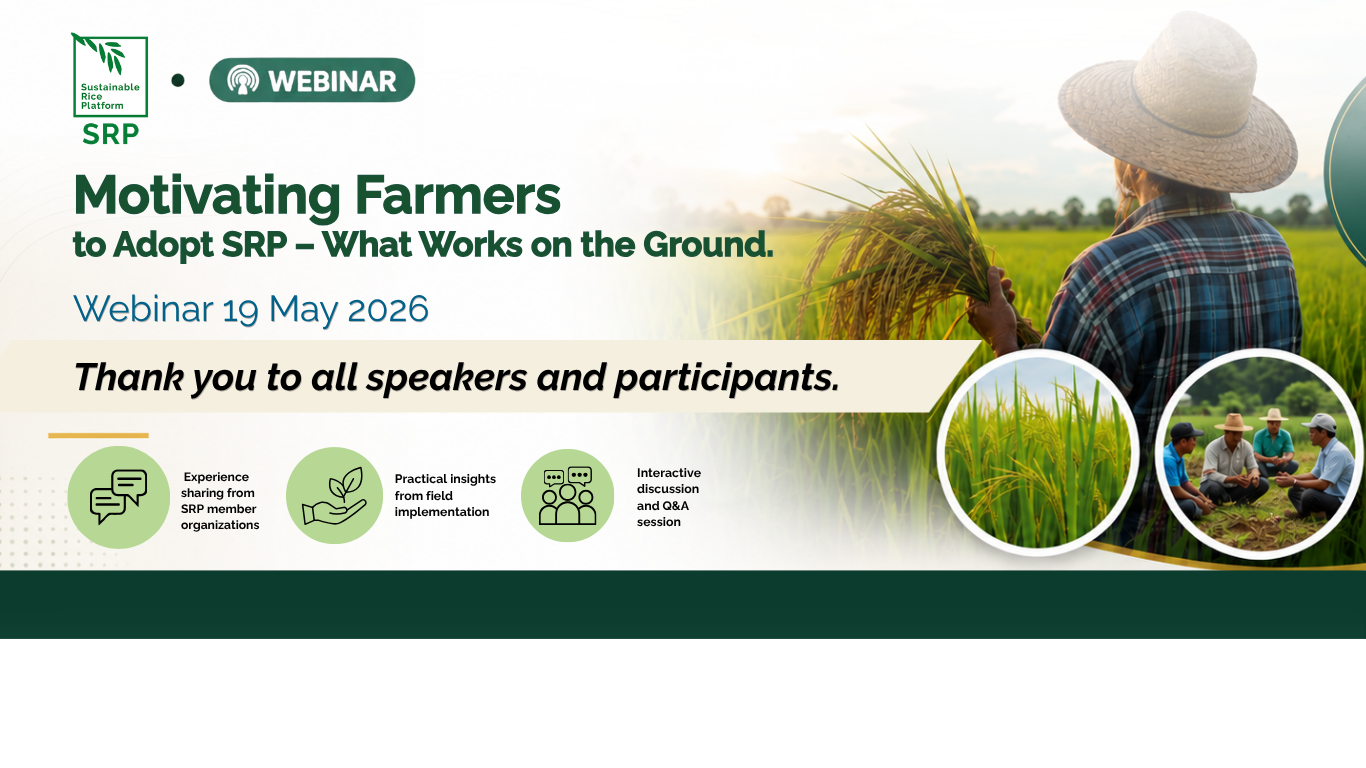
Webinar Recap: Motivating Farmers to Adopt SRP–What Works on the Ground
Date: 19 May 2026
Time: Session 1: 08:00–08:45 (UTC+7 | Thailand Time)
Session 2: 19:00–19:45 (UTC+7 | Thailand Time)
Venue: Online (MS Teams Webinar)
The Sustainable Rice Platform (SRP) recently hosted an exclusive members’ webinar, “Motivating Farmers to Adopt SRP – What Works on the Ground,” bringing together experts, researchers, and implementation partners to exchange practical experiences on encouraging farmers to adopt sustainable rice farming practices. The webinar also demonstrated growing engagement across the SRP member community. Following SRP’s first members’ webinar, which received 85 registrations, this latest session attracted 134 registrations across both sessions, with a live participation rate of over 70%, representing 95 attendees joining from different regions worldwide. The increase highlights the expanding interest in peer learning, practical implementation experiences, and collaborative knowledge sharing within the SRP network.
This achievement reflects the increasing commitment of the SRP community to collaboration, knowledge sharing, and advancing sustainable rice production globally. We would like to sincerely thank all participants, speakers, and members who joined the session and contributed to the meaningful discussions. Your engagement and shared experiences are what make the SRP community stronger and continue driving impact on the ground.
About the Webinar
Session 1
The first session featured three distinguished speakers representing diverse implementation contexts across Asia and Africa:
- Dr. Atthawit Watcharapongchai from GIZ Thailand Agriculture Cluster – GIZ
- Assoc. Prof. Phumsith Mahasuweeracha from EEI-LMS, Faculty of Economics, Khon Kaen University
- Mr. Anthony Mugambi from Kilimo Trust
Together, the speakers explored practical approaches that drive farmer engagement, increase adoption rates, and strengthen long-term sustainability outcomes in rice production systems.
Opening the session, SRP highlighted an important question: What happens when sustainability standards move beyond documents and enter real farming communities? The webinar focused on lessons learned from implementation on the ground, demonstrating how trust, profitability, peer learning, and local engagement can influence farmer adoption of SRP practices.

Dr. Atthawit shared over a decade of experience implementing SRP in Thailand and reflected on how farmer engagement has evolved over time. He highlighted that successful adoption begins with making sustainability profitable, helping farmers clearly understand how improved practices can reduce production costs, increase yields, and benefit livelihoods. He also emphasized the importance of demonstration farms, record keeping, and local community learning in building long-term trust among farmers.
Dr. Atthawit Watcharapongchai
Head InS Regenerative Agriculture Thailand Asia 7 and Head of Field Operation of Thai Rice GCF, GIZ Thailand Agriculture Cluster – GIZ

Assoc. Prof. Phumsith presented research findings and implementation experiences from Northeast Thailand, focusing on smallholder farmers adopting SRP practices. He explained that while market access is important, it is not always enough to convince farmers to adopt new practices. Instead, mentorship systems, trusted early adopters, and farmer-to-farmer learning were identified as stronger drivers of behavioral change. However, access to premium markets remains essential for maintaining long-term participation.
Assoc. Prof. Phumsith Mahasuweerachai
Director of EEI-LMS, Faculty of Economics, Khon Kaen University

Representing experiences from East Africa, Mr. Anthony shared implementation lessons from Kenya and Uganda, where SRP adoption is still developing. He highlighted the importance of trust and community engagement, participatory cost-benefit analysis, and demonstration plots that allow farmers to directly compare conventional and SRP practices. Cross-border learning between farming communities was also identified as an effective way to accelerate adoption and improve implementation outcomes.
Mr. Anthony Mugambi
Kenya Country Manager, Kilimo Trust
Q&A and Reflections from the Speakers Session 1
Reflection Question:
Q. Was there any moment during implementation that surprised you personally?
A. Dr. Atthawit shared that one unexpected moment came when auditors asked farmers what they had learned through SRP implementation. Some farmers mentioned women’s empowerment and gender equality, which surprised him, as these topics had not initially been considered major issues in the local context. He reflected that sustainability messages shared repeatedly with farmers may influence attitudes beyond farming practices alone.
A. Mr. Anthony highlighted the impact of farmer exchange learning between Kenya and Uganda. He shared examples where farmers visiting neighbouring communities learned new approaches to cropping calendars and water management, later adapting these practices in their own areas. According to his experience, farmers learning from other farmers often creates stronger influence than receiving information directly from experts.
Participant Question:
Q. What motivates farmers to continue adopting SRP practices over time?
A. Assoc. Prof. Phumsith noted that market availability alone may not be sufficient to encourage farmers to initially adopt SRP, as changing practices involves risks and uncertainty. However, once farmers observe benefits such as improved yields, reduced costs, and access to premium markets, these factors become important in maintaining long-term participation. He emphasized that trusted local examples, mentorship, and early adopters often play a stronger role in encouraging initial adoption.
Session 2
The second session featured three distinguished speakers representing diverse implementation contexts across Asia and Africa:
- Mr. Anthony Mugambi from Kilimo Trust
- Mr. Vikram Mehla from LT Foods Limited
- Ms. Hi Tran from Olam Global Agri Vietnam

Anthony Mugambi discussed challenges facing farmers in Kenya and Uganda, including climate variability, limited agricultural extension services, and demand for immediate economic returns. Anthony repeatedly highlighted the importance of trust and community engagement, explaining that farmers are more willing to adopt sustainable practices when recommendations come from respected peers or familiar local actors.
Mr. Anthony Mugambi
Kenya Country Manager, Kilimo Trust

Vikram Mehla shared lessons from LT Foods’ work with farmers across India and Pakistan. LT Foods was among the earliest adopters of SRP standards and became the first company globally to achieve the highest SRP verification level. Vikram emphasized that economic incentives are essential, particularly during the first year of implementation when farmers may not yet experience measurable yield improvements.
Mr. Vikram Mehla
Senior Manager, Agribusiness / Chair of SRP Technical Committee, LT Foods

Hi Tran shared practical experiences from implementing SRP with smallholder farmers in Vietnam, highlighting how long-term engagement, demonstration-based learning, and strong farmer relationships can support the adoption of sustainable rice farming practices. She emphasized that farmers are more likely to embrace new approaches when they can observe tangible benefits firsthand, including improved efficiency, reduced input use, and strengthened livelihoods.
Ms. Hi Tran
Head of Procurement and Sustainability for Vietnam and Cambodia, Olam Agri
Q&A and Reflections from the Speakers Session 2
Q: What are the biggest behavioral barriers preventing farmers from adopting SRP practices?
A: Speakers agreed that one of the greatest challenges is resistance to changing long-established farming practices. Farmers often prioritize immediate returns and may hesitate to adopt unfamiliar approaches without visible short-term benefits.
Q: How important is market demand in motivating farmers?
A: Speakers emphasized that market demand and stable buyers are major drivers of adoption. Moreover, one speaker stressed that without market demand, adoption becomes significantly more difficult.
Key Takeaways
Across both sessions, several common lessons emerged:
- Farmers need to see clear economic benefits.
- Trust and local engagement are essential.
- Peer learning and demonstration plots are highly effective.
- Patience and continuous support are critical for long-term adoption.
- Strong market linkages help scale sustainable rice production.
The webinar reinforced that sustainable rice farming is not only about introducing standards, but also about building trust, demonstrating value, and supporting farmers through long-term collaboration.
Looking Ahead
The webinar concluded with SRP sharing updates on upcoming learning opportunities for members. Following the recent Low Carbon Assurance Model (LCAM) workshop, conducted under the ISEAL Replication Fund activities, SRP and partners are currently preparing a future workshop focused on quantifying Scope 3 GHG reductions in rice cultivation. The workshop is expected to take place around August–September, with further details to be announced soon. These continued initiatives reflect SRP’s commitment to supporting members in climate-related measurement, emissions reduction, and sustainability impact within the rice sector.
By Thanaporn Thammawongsa, Jidapa Noosawas
Related Post
SRP’s New Member — A Warm Welcome to Quality Foods Industries
The Sustainable Rice Platform (SRP) is pleased to welcome Quality Foods Industries as a new member of the SRP community, marking a shared commitment to advancing sustainable rice production and strengthening collaboration across the global
Read More
SRP’s New Member — A Warm Welcome to Highland Dragon Long An Rice Mill Plant (HDELA)
The Sustainable Rice Platform (SRP) is pleased to welcome Highland Dragon-Long An Rice Mill Plant (HDELA) as a new member of the SRP community, marking a shared commitment to advancing sustainable rice production and strengthening
Read More
SRP’s New Member — A Warm Welcome to Khmer Foods Group
The Sustainable Rice Platform (SRP) is pleased to welcome Khmer Foods Group Co., Ltd. as a new member of the SRP community, marking a shared commitment to advancing sustainable rice production and strengthening collaboration across
Read More
SRP’s New Member — A Warm Welcome to Fatima Euricom Rice Mills Pvt. Ltd
We're delighted to welcome Fatima Euricom Rice Mills Pvt. Ltd into the Sustainable Rice Platform (SRP) family. Their membership reflects a growing, shared drive to build a more sustainable and resilient future for rice production
Read More
Sustainable Rice Platform (SRP) Welcomes Bioagricert as a New Member
The Sustainable Rice Platform (SRP) is pleased to welcome Bioagricert as a new member of the SRP community, marking a shared commitment to advancing sustainable rice production and strengthening collaboration across the global rice sector.
Read More
Sustainable Rice Platform (SRP) Welcomes C. P. Intertrade as a New Member
The Sustainable Rice Platform (SRP) is pleased to welcome C. P. Intertrade Co., Ltd. as a new member of the SRP community, marking a shared commitment to advancing sustainable rice production and strengthening collaboration across
Read More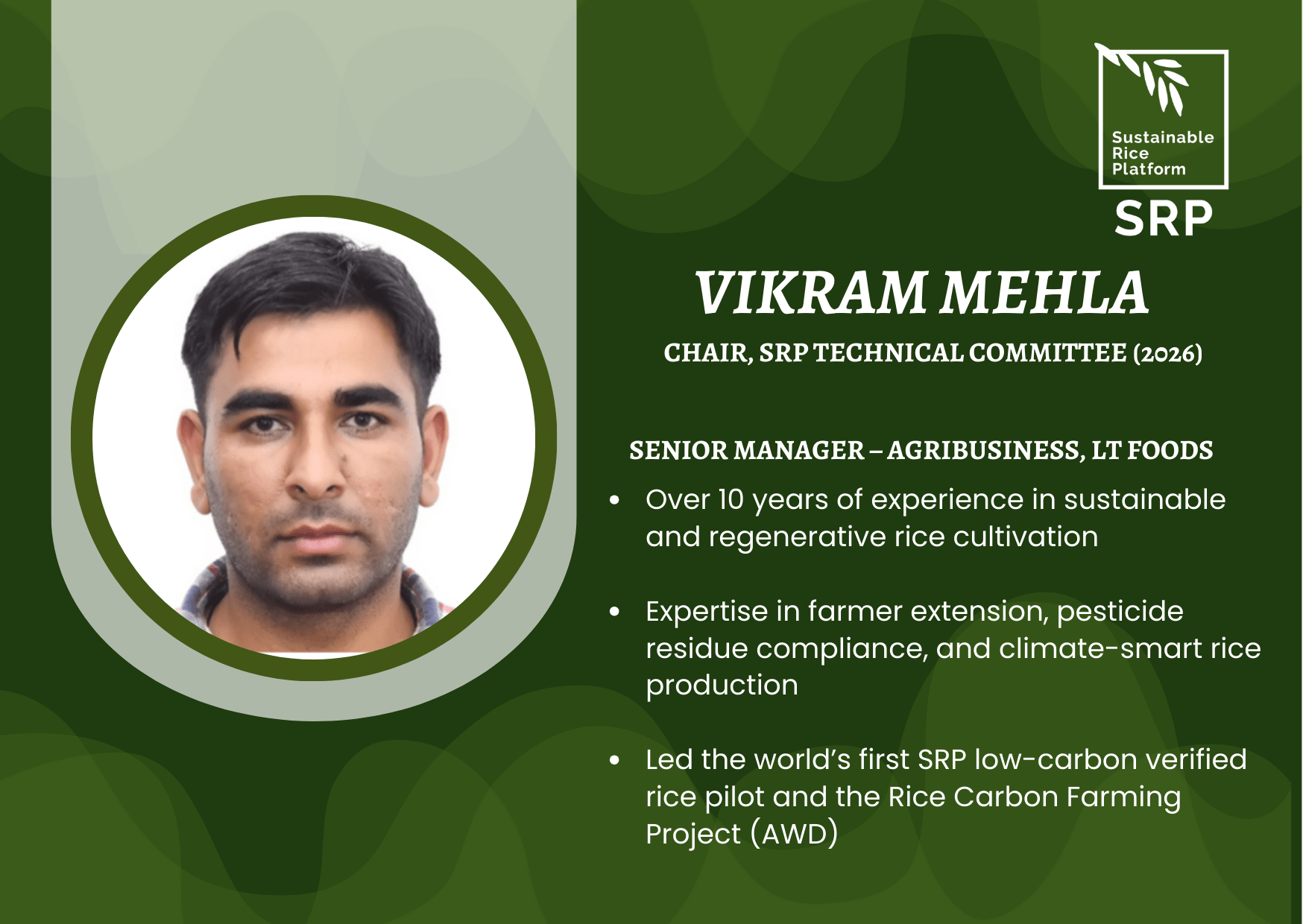
Announcing the New Chair of the SRP Technical Committee
Sustainable Rice Platform (SRP) is pleased to welcome Vikram Mehla, Senior Manager-Agribusiness at LT Foods, as the newly elected Chair of the SRP Technical Committee (TC) for 2026. Vikram brings over a decade of experience in advancing sustainable and regenerative rice cultivation, working closely
Read More
Welcome new SRP member
We are excited to welcome new members to the Sustainable Rice Platform. Your participation is vital to driving innovation and sustainability across the global rice value chain. Learn more about our new member from their
Read More
Welcome new SRP member
We are excited to welcome new members to the Sustainable Rice Platform. Your participation is vital to driving innovation and sustainability across the global rice value chain. Learn more about our new member from their
Read More
Welcome new SRP member
We are excited to welcome new members to the Sustainable Rice Platform. Your participation is vital to driving innovation and sustainability across the global rice value chain. Learn more about our new member from their
Read More