Webinar Recap: SRP CoC v2.6 & Brand Manual v2.0 Webinar — What’s New and What It Means for You
Date : 9 July 2026 Time: First Info Session: 08:00–09:00 (Thailand Time, UTC+7) Second Info Session: 19:00–20:00 (Thailand Time, UTC+7)
Venue: Online (MS Teams Webinar)
On 9 July 2026, SRP hosted the very first session of our new SRP Knowledge & Learning Webinar Series and it landed as a genuine success: 72 attendees across two sessions, from 19 countries and regions spanning Asia, Africa, Europe, and the Americas. This session was exclusively for SRP members, CoC Authorized Trainers, and CABs. For a first-ever session, that kind of reach and turnout is exactly the signal we hoped for.
The topic: Everything about SRP CoC Policy & Standard v2.6 and the SRP Brand Manual & Claims Guidelines v2.0 — what’s changed, and what it means for you.
Why This Webinar, Why Now
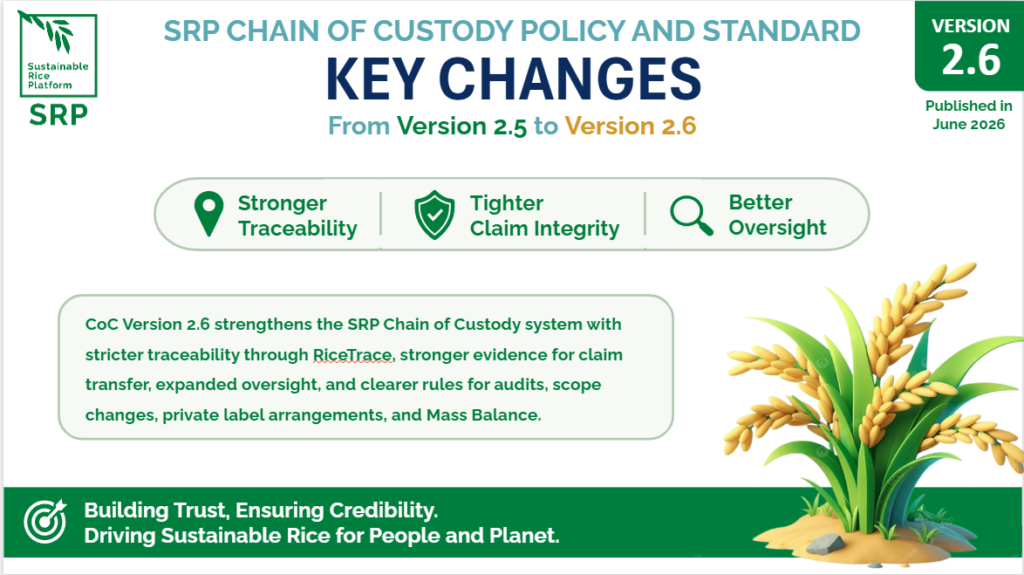
Behind this session sits a bigger story. Earlier this summer, SRP released updated versions of both the CoC Policy & Standard and the Brand Manual & Claims Guidelines, alongside a brand-new Private Label Agreement (PLA) Template. These are not s mall achievements. As markets and consumers demand greater accountability for sustainability claims, v2.6 strengthens the systems that make SRP-Verified rice trustworthy from farm to final consumer: RiceTrace is now the sole official system of record for transactions and claims, the rules around multi-ingredient and private-label products are clearer, Transaction Certificates carry stronger safeguards, and CABs play an elevated role in maintaining data integrity throughout the Assurance Framework.
Updates of this scale don’t mean much if they stay buried in a PDF. That’s exactly why we hosted this webinar: to walk members, trainers, CABs, and the wider industry through what actually changed, what it means for day-to-day operations, and how to apply it correctly directly from the people closest to the work.
Because our community spans the globe, we ran the session twice: one at 08:00–09:00 ICT and a second at 19:00–20:00 ICT, so colleagues from Asia to the Americas could join at a reasonable hour.
A Truly Global Room
Session one brought together 33 registrants and 28 attendees (not counting the SRP team and speaker), joining us from Thailand, Cambodia, Uruguay, Vietnam, Indonesia, Argentina, Côte d’Ivoire, and India.
Session two drew even more interest: 54 registrants and 44 attendees (again, not counting the SRP team and speaker), joining from India, Pakistan, the UK, Poland, the Netherlands, Germany, Uruguay, Vietnam, the Benelux region, Myanmar, Indonesia, the United States, Spain, Estonia, and Denmark.
Combined, that’s 72 attendees from 19 countries and regions across four continents, for the very first edition of the SRP Knowledge & Learning Webinar Series. Seeing that spread on our screen was a genuine reminder of how far and wide the SRP community and its influence has reached.
A First for SRP: Our Champion Trainer Takes the Stage
This webinar marked a special milestone: it was the first time an SRP Champion Trainer led an SRP webinar session. Both sessions featured Le Trong Lu, Ph.D., SRP Training Specialist at Peterson Services Vietnam and SRP’s first-ever Champion Trainer, recognized for delivering the highest number of SRP trainings of any trainer in 2025.
With over 14 years of experience in agriculture and a long track record of helping farmers and businesses across Vietnam adopt the SRP Standard, Dr. Le brought real, on-the-ground perspective to the updates exactly the kind of practical, field-tested guidance our SRP Knowledge & Learning Webinar Series was designed to deliver. Having a Champion Trainer, not just an SRP Secretariat speaker, walk members through the CoC and Brand Manual changes made the session feel grounded and immediately applicable. Learn more about him here: Meet Our SRP Champion Trainer – Sustainable Rice Platform (SRP)
Putting Understanding to the Test
To help participants gauge how well the updates had landed, we closed each session with a short quiz on the key changes in CoC v2.6 and Brand Manual v2.0. The average score came in at 95/100 — a solid result, but also a useful signal of where members may want to revisit the documentation a little more closely.
Understanding doesn’t stop at a quiz score, of course, which is exactly why we made sure to leave ample room for live questions in both sessions.
Your Questions, Answered
Across both sessions, participants raised sharp, practical questions about how the updated CoC Policy & Standard and Brand Manual apply to their day-to-day work. Here’s a consolidated recap (names omitted):
Q: What type of exceptions will be approved by SRP?
A: SRP may grant exemptions only where there is a justified reason, and the exemption does not compromise the integrity or traceability of the SRP system. All exemptions must be approved by the SRP Secretariat. In addition, Section 4.5.3 introduces further clarification on how such exemptions should be documented and managed within the system, while ensuring that the process remains practical and does not create excessive administrative burden for participating entities. Please refer to Section 4.5 – Exemptions page 41 of the SRP CoC Policy & Standard v2.6 for the details.
Q: Could process waste be considered in the calculation of claimable volume?
A: Yes. By-product from the processing of SRP-Verified rice can be claimed as SRP-Verified by-product, provided they are derived from eligible SRP-Verified input. These by-products must be registered in the RiceTrace system using the Initial Volume function before they can be transferred through SRP transactions.
Q: For a mixed rice product (SRP-Verified rice blended with other, non-SRP rice), can the SRP label be used on-pack if the percentage of SRP rice is indicated?
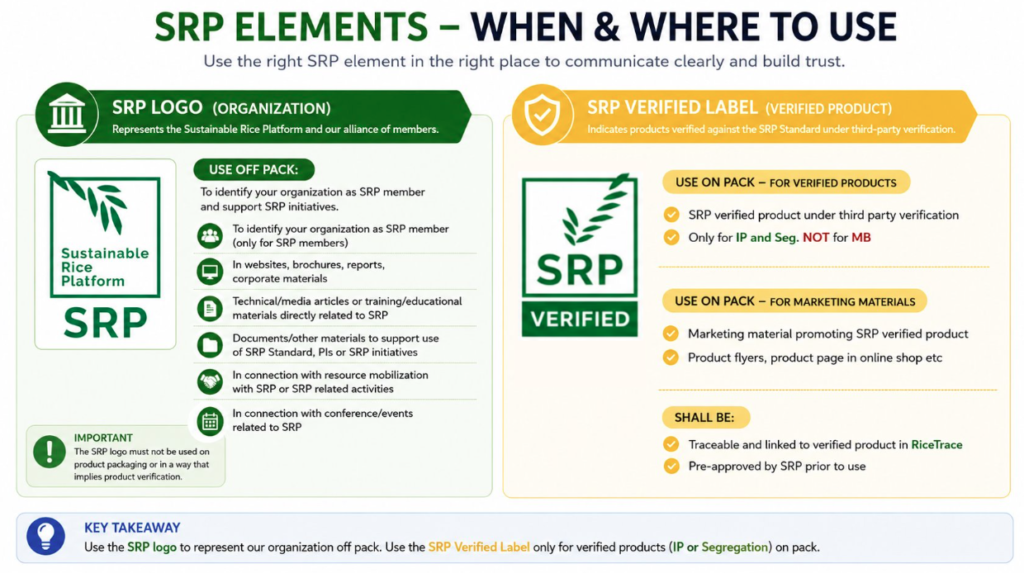
A: No. A mixed rice product is considered a Mass Balance (MB) product. Therefore, it cannot carry the SRP-Verified label on-pack, even if the percentage of SRP-Verified rice is stated. Instead, it may use one of the authorized Mass Balance claims in accordance with the SRP Brand Manual & Claim Guidelines.
Q: Can a non-member use the SRP logo off-pack, and does a customer need approval from SRP and a signed private label agreement to use the SRP-Verified label on-pack, regardless of their own membership status?
A: Use of the SRP Organisational logo is primarily reserved for SRP members. That said, third-party organizations may request use on a case-by-case basis for example, as an event partner, sponsor, or co-host. As outlined in the SRP Brand Manual & Claims Guidelines (p. 8), any organization wishing to use the SRP Organisational logo to describe SRP or its activities must first obtain written permission from the SRP Secretariat.
Use of the SRP-Verified label on-pack is different. It is only permitted for products sourced through the Identity Preserved (IP) or Segregation (Seg) Chain of Custody models that have been verified by an independent third-party Conformity Assessment Body (CAB). In addition, all on-pack artwork must be approved by the SRP Secretariat, and the brand owner must sign an SRP Private Label Agreement before the label can be used, regardless of SRP membership status.
Q: How is a “transaction” defined? Is it one purchase order and its corresponding invoice, or a single shipment?
A: In the RiceTrace system, a transaction accompanied with a Transaction Certificate, it is the transfer of SRP claims between the same seller and the same buyer. It is not defined by a single purchase order, invoice, or shipment. A single transaction may include multiple purchase orders, invoices, shipments, and containers, provided they are between the same seller and buyer and all shipments occur within a maximum period of 30 days.If the shipments fall outside the 30-day period or involve a different buyer, a new transaction should be created.
Q: On initial volume rules — if there are missing volumes after a Transaction Certificate has been issued, and it isn’t a by-product case, can an initial volume request still be submitted to restore the missing volume in RiceTrace inventory?
A: Initial volume was originally designed to register existing volume at the time RiceTrace was introduced, and volume from producers without Participating Operator (PO) access. By-product may also need to be registered this way, if it will be transferred with a SRP claim. Beyond that, missing-volume cases are reviewed individually, based on the specific circumstances and evidence provided. If SRP advises using the initial volume function to correct inventory, that guidance applies to that specific, exceptional case.
Q: Is the Private Label Agreement (PLA) available for download by POs and CABs, or does it need to be requested directly from the SRP Secretariat?
A: It’s available on the SRP Resources page and also in Document section in RiceTrace — no need to request it separately.
Thank You
A big thank-you to everyone who joined us across both sessions, and especially to Dr. Le Trong Lu for setting a high bar as our first Champion Trainer to lead an SRP webinar. If you missed this session or want to revisit the details, the full updates are available here:
- A New Standard for Rice Traceability: SRP Chain of Custody Policy v2.6 Is Here
- New SRP Brand Manual & Claim Guidelines Now Available
- SRP CoC Policy & Standard v2.6 (PDF)
- Videos available on SRP Youtube Channel: SRP CoC Policy & Standard Version 2.6 and SRP Brand Manual Version 2.0
Have a question we didn’t cover? Reach out to the SRP Secretariat anytime — we’re always happy to help you apply these updates with confidence.
By Jidapa Noosawas
Related Post
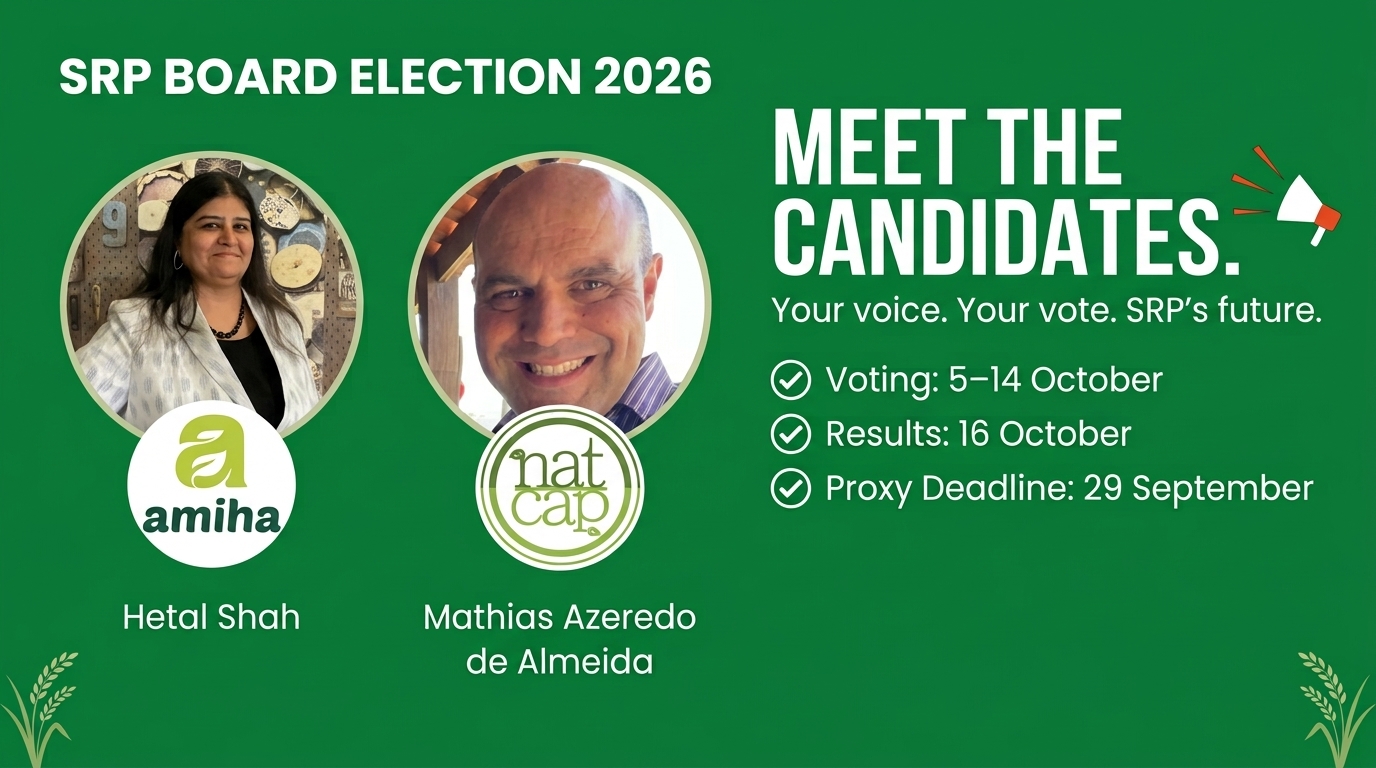
SRP Board Election: One Seat, Two Outstanding Candidates, Your Vote Shapes What Comes Next
The SRP Board sets the direction for our entire movement — and this year, one seat, two exceptional leaders, and every member's vote will decide who helps steward that future. This is your moment to
Read More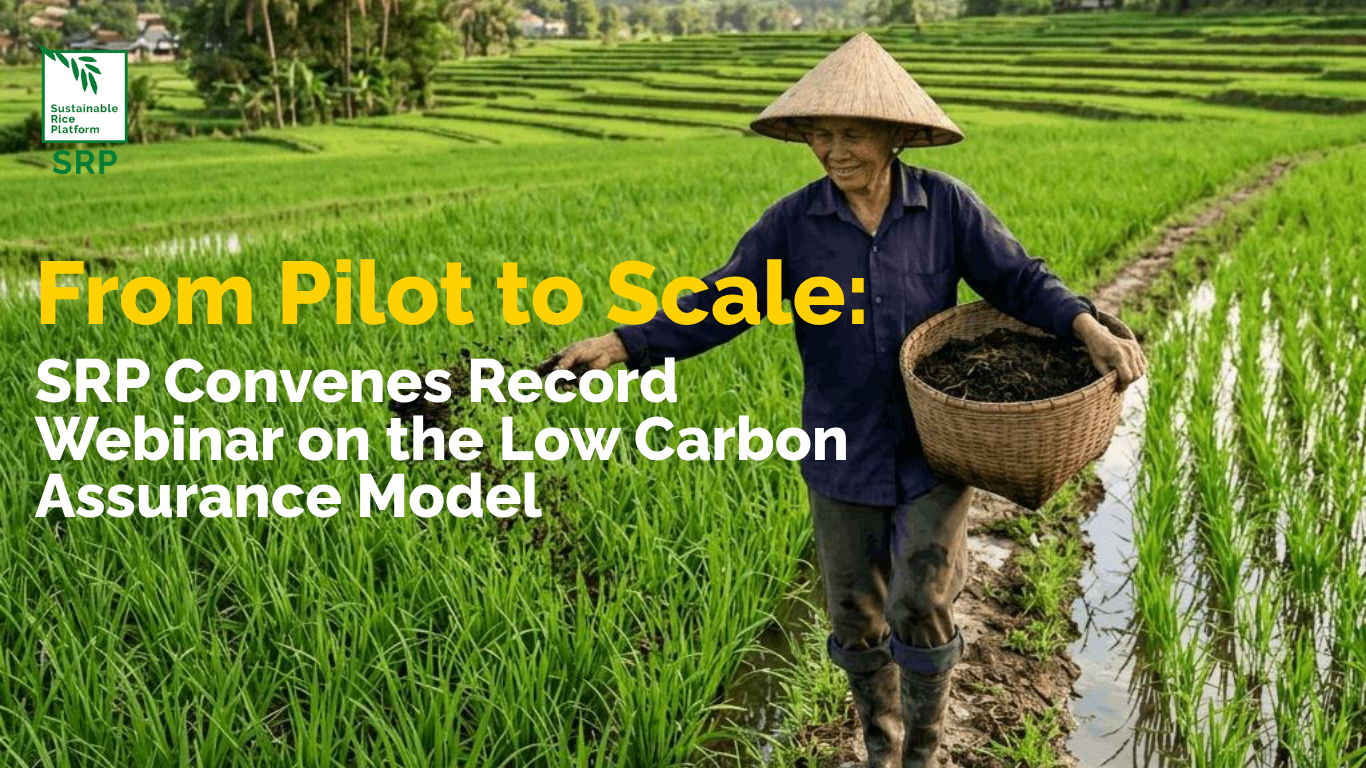
From Pilot to Scale: SRP Convenes Record Webinar on the Low Carbon Assurance Model
Nearly 300 registrants of this webinar, the Value Change Initiative and private-sector buyers to shape the pathway from LCAM's India and Vietnam pilots to sector-wide implementation BANGKOK, 2 September 2026 — The Sustainable Rice Platform (SRP) today convened one of
Read More
Meet the Speakers: From Pilot to Scale – Shaping the Future of L-CAM | SRP Webinar, 2 September 2026
For a solution to matter at scale, it has to survive contact with the real world — different geographies, different value chains, different buyers asking different questions. That's exactly the stage SRP's Low-Carbon Assurance Module
Read More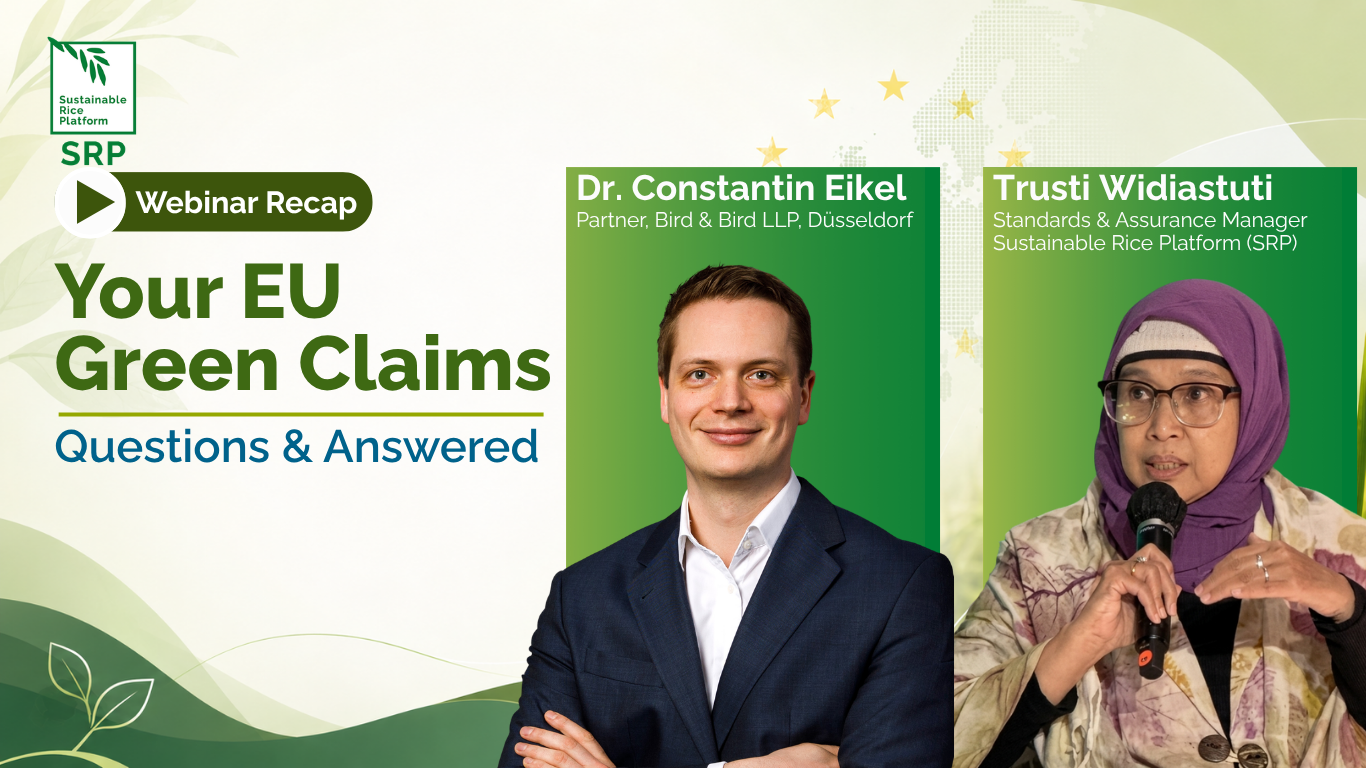
SRP Webinar Recap: Your EU Green Claims Questions, Answered
On 20 August 2026, the Sustainable Rice Platform (SRP) hosted a webinar on the EU Empowering Consumers for the Green Transition (EmpCo) Directive and what it means for sustainability claims in the rice sector. Moderated
Read More
Call for Nominations: SRP Board Election — One Seat, One Vote, Your Voice
Nominations open 20 August 2026 This is your moment to help steer the future of the Sustainable Rice Platform. One seat on the SRP Board — At Large — is opening up. Unlike seats reserved
Read More
How SRP prepared for the EU Empowering Consumers for the Green Transition Directive
The EU Empowering Consumers for the Green Transition (EmpCo) Directive (Directive (EU) 2024/825) introduces new requirements to improve the transparency and credibility of environmental claims and sustainability labels, helping consumers make better-informed purchasing decisions. SRP is committed
Read More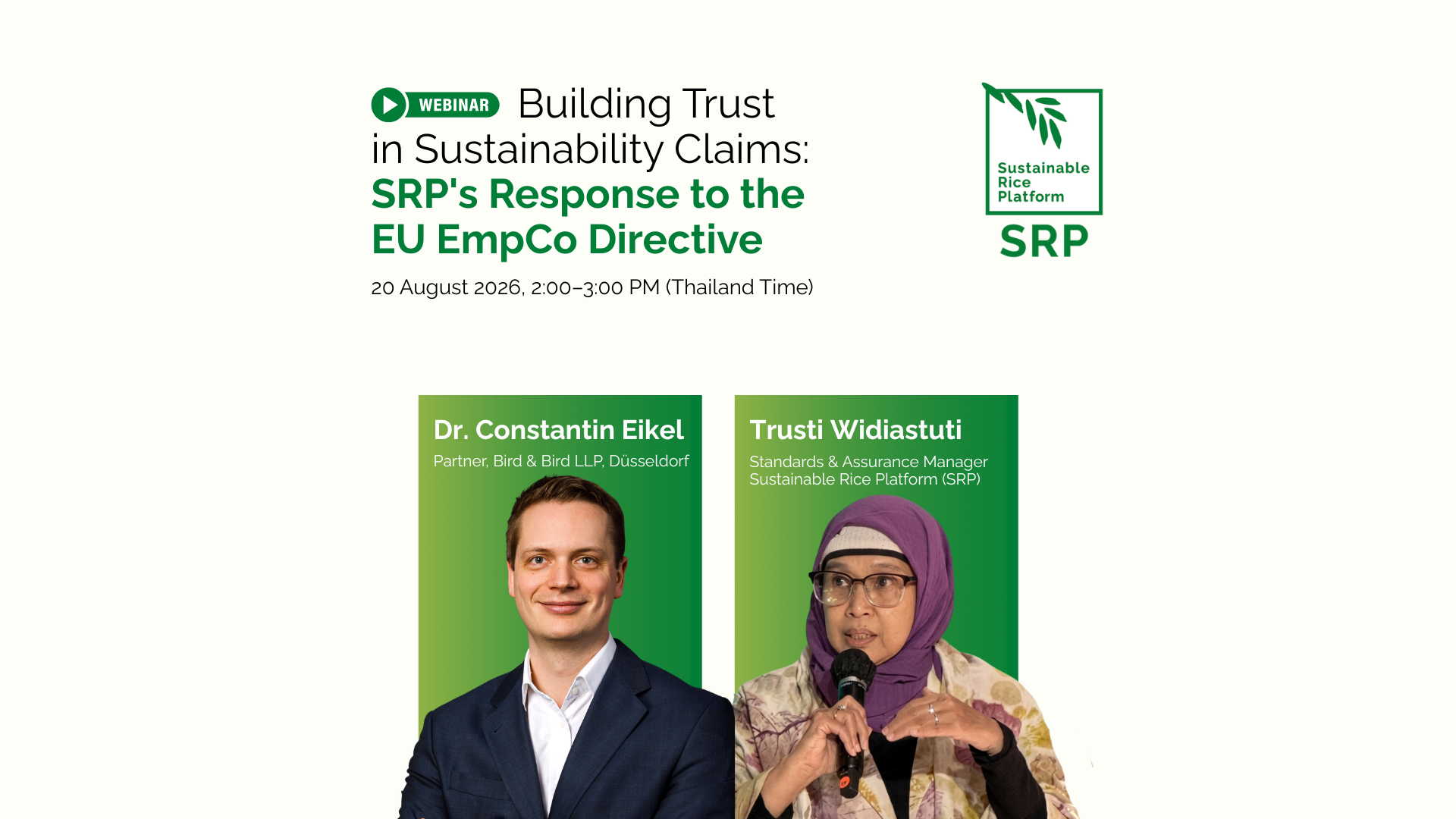
Meet the Speakers: Building Trust in Sustainability Claims: SRP’s Response to the EU EmpCo Directive | SRP Webinar, 20 August 2026
Starting 27 September 2026, the EU's EmpCo Directive comes into force — and it will fundamentally change how brands can talk about sustainability. Broad, unverified claims like "eco-friendly" or "green" won't hold up anymore unless
Read More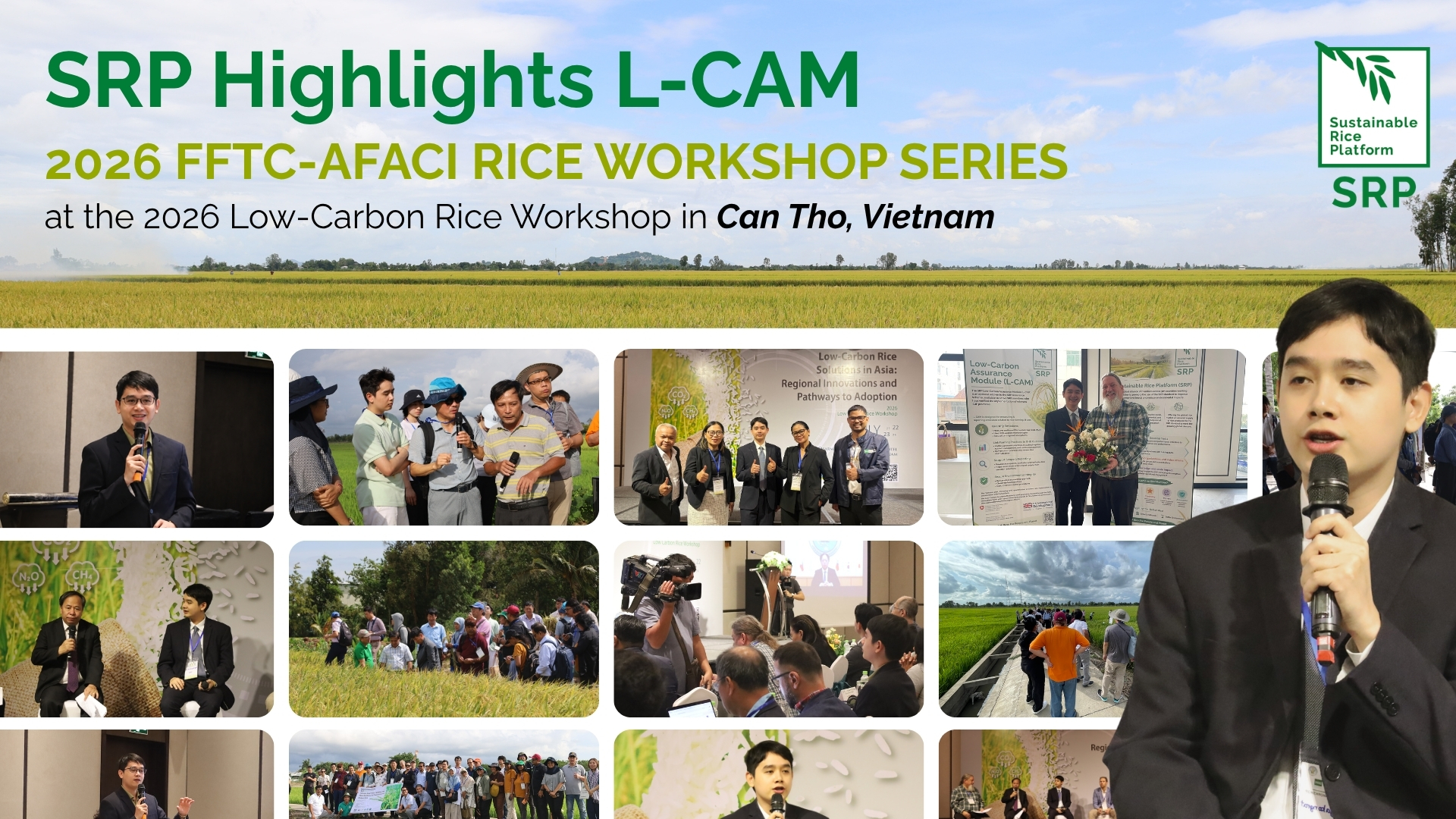
SRP Highlights L-CAM: 2026 FFTC-AFACI RICE WORKSHOP SERIES at the 2026 Low-Carbon Rice Workshop in Can Tho, Vietnam
From 22 to 24 July 2026, the rice world turned its attention to Can Tho City, Vietnam, for the FFTC workshop "Low-Carbon Rice Solutions in Asia." For the Sustainable Rice Platform (SRP), it was more than a
Read More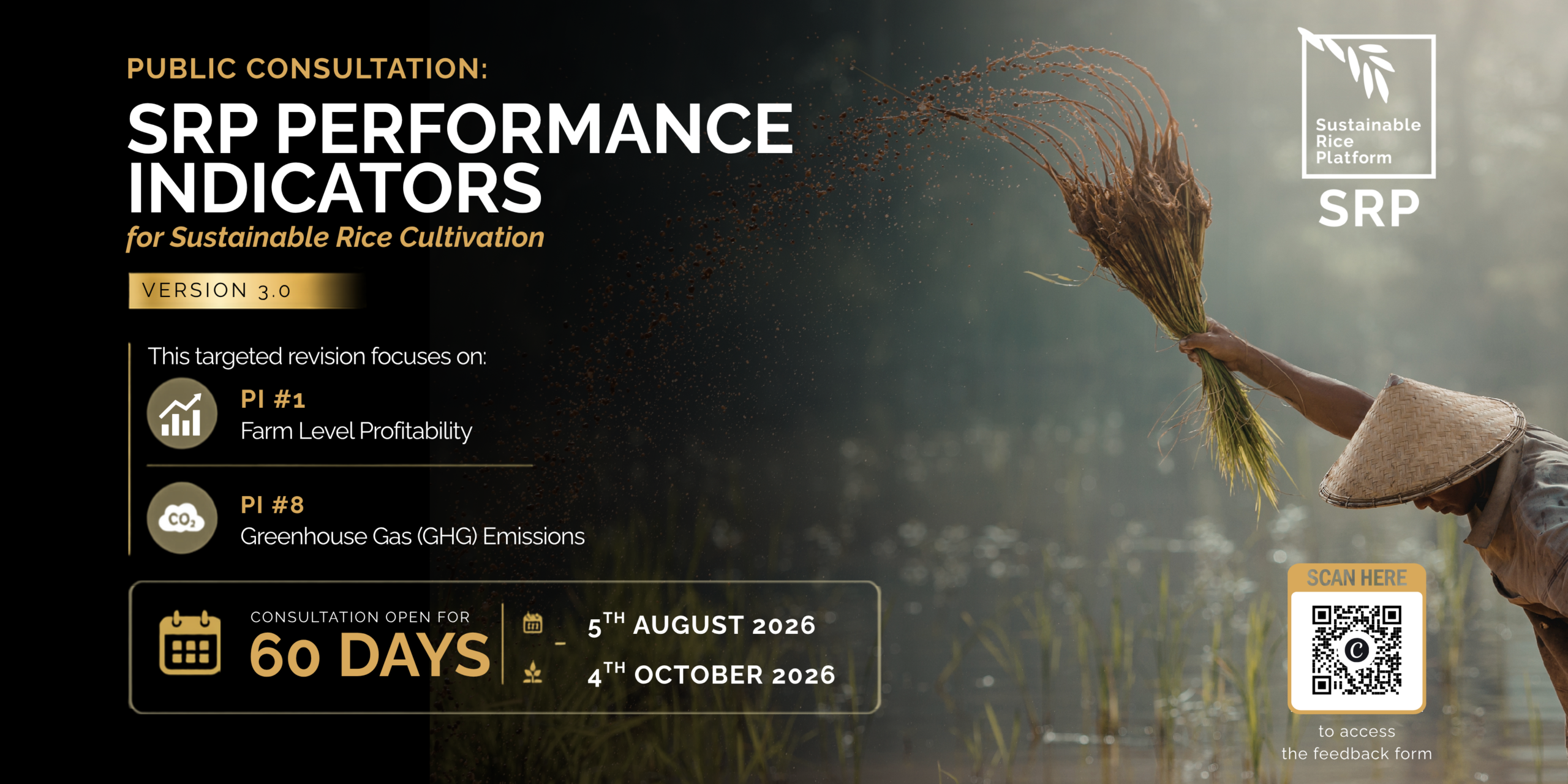
Public Consultation Open: Revision of SRP Performance Indicators for Sustainable Rice Cultivation
The Sustainable Rice Platform (SRP) invites stakeholders to participate in a 60-day public consultation on the proposed revision of the SRP Performance Indicators for Sustainable Rice Cultivation. The SRP Performance Indicators support the measurement of sustainability outcomes associated with rice cultivation and
Read More
Join Thai Webinar: Upgrade Thai Rice Production to meet an international market
As sustainability expectations continue to reshape global agricultural markets, the rice sector is entering a new era where transparency, traceability, and credible sustainability practices are becoming essential. To support stakeholders in navigating this transition, the
Read More