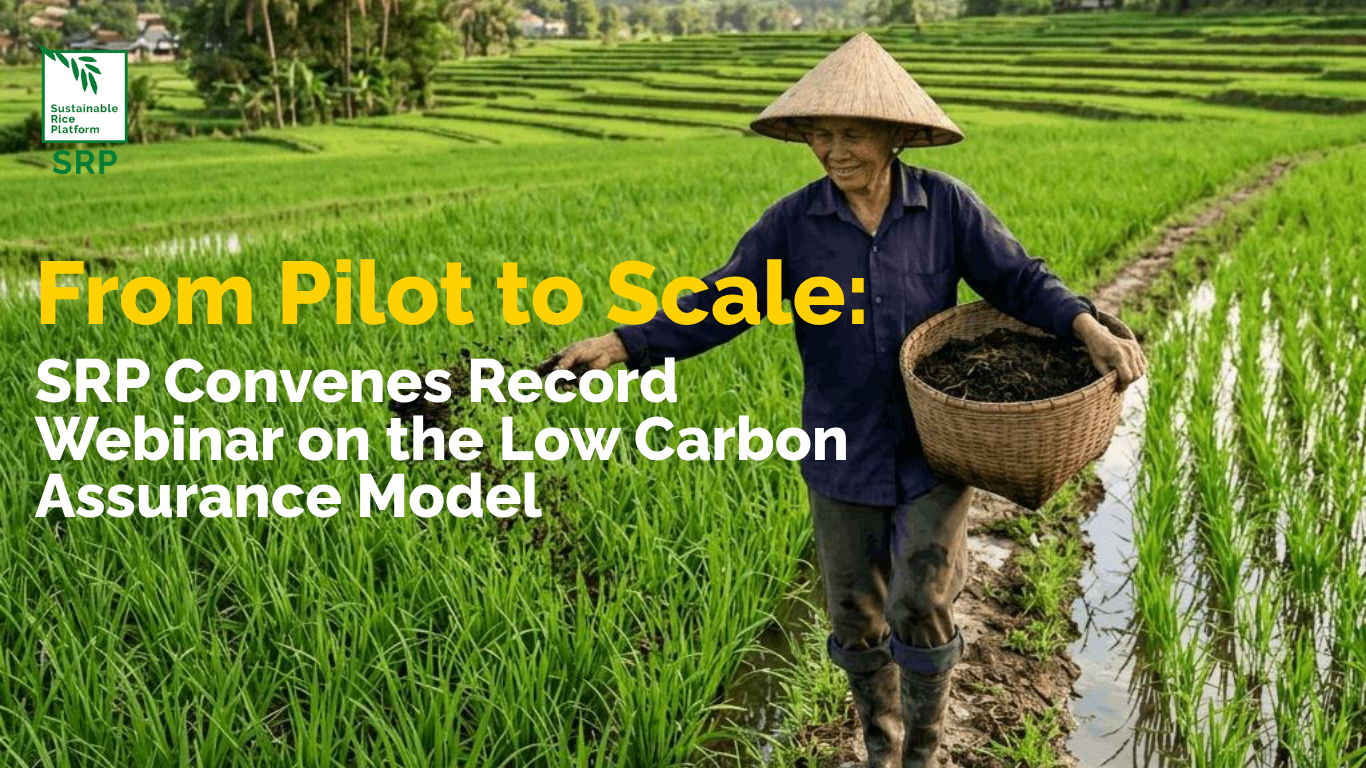
From Pilot to Scale: SRP Convenes Record Webinar on the Low Carbon Assurance Model
Nearly 300 registrants of this webinar, the Value Change Initiative and private-sector buyers to shape the pathway from LCAM’s India and Vietnam pilots to sector-wide implementation
BANGKOK, 2 September 2026 — The Sustainable Rice Platform (SRP) today convened one of the largest webinars in its history, drawing close to 300 registrations for a session on the Low Carbon Assurance Model (LCAM) — the model that converts SRP-verified farming practices into greenhouse gas information credible enough for corporate Scope 3 reporting. Titled *”From Pilot to Scale: Shaping the Future of LCAM — Co-creating the pathway for implementation and adoption”*, the session marked a deliberate shift in how SRP communicates the initiative: rather than presenting through SRP’s own channels alone, the agenda was built around external stakeholders, including a standards body and two of the industry’s leading sustainable-procurement practitioners.
The webinar came as LCAM completes its second pilot phase. First developed in India under the Innovation Fund with funding from SECO and the UK government, the model has now been replicated in Vietnam, with region-specific guidance developed for both countries. The LCAM modules, including full eligibility criteria, are due for publication following the Vietnam phase.
Hosting the session, Tun Boonyakongrat, Senior Membership and Communications Officer at SRP, opened by asking attendees what the sector must not leave behind on the road to low-carbon rice. The live responses — credibility, farmers’ livelihoods, soil health, robustness, verifiability, community — set the tone for the two hours that followed.
LCAM is an extension of the SRP Standard, not a new framework
Trusti Widiastuti, Standard and Assurance Manager at SRP, framed the model’s scope and was emphatic on one point: LCAM is not a standalone framework or system. The practices that drive emission reductions — improved water management including alternate wetting and drying, better nutrient and fertiliser management, residue management, and shortened cropping seasons — are already embedded in the SRP Standard, and are already closely aligned with the SRP verification audit.
“The challenge is not the farming practices, because the practices are being introduced through the SRP Standard,” Widiastuti told attendees. “The challenge is turning those verified practices into credible emission information that buyers can report in their Scope 3 reporting.”
That demand is being driven by major food companies — Mars, Unilever, Nestlé, PepsiCo and others were named — seeking Scope 3 data that is both credible and accountable. Widiastuti set out two pathways for buyers: switch to sourcing from SRP-verified producers already generating LCAM outcomes or support their own producers to adopt the SRP Standard and then the model. In both cases the SRP Standard is the entry point, and third-party assurance is integral rather than optional.
Eligibility criteria presented during the session require that a producer group is not enrolled in — or planning to enrol in — any carbon-credit-generating project, a condition designed explicitly to prevent double counting or double claiming. Participants must also plan to undergo SRP assurance for at least one rice-growing season, must have been applying SRP Standard practices within the last three years, and must have an Internal Management System with governance strong enough to support farm-level data collection.
Widiastuti also clarified the division of labour as LCAM scales: SRP stewards the protocol and framework, approves communications and claims, and coordinates partners and governance; MRV technical partners supply the data-collection infrastructure and work with producer groups and conformity assessment bodies; and off-takers receive the outcomes for use in Scope 3 reporting and target setting.
“Remote first, but not remote only”
Presenting the MRV architecture, Devon explained that LCAM was designed around a single test: the numbers must be usable in corporate Scope 3 reporting, not merely interesting. “We don’t want the numbers to just be for curiosity,” she said. “For that to be true, the numbers need to stand up to scrutiny — there needs to be an appropriate amount of activity data behind the result, and a verifiable evidence trail.”
This phase of LCAM leans heavily on remote sensing, for two reasons: it raises confidence in the practices that fundamentally drive rice emissions, such as season length and irrigation regime, moving away from purely self-reported data; and it delivers coverage at scale across every field in an IMS rather than depending on sampling for those core signals.
The approach was characterised as “remote first, but not remote only”. Crop presence, seeding and harvest dates, irrigation regime and group-level straw-burning indicators are captured remotely. Field boundaries, fertiliser application and other data points that satellites cannot detect are collected manually — using data that already exists where possible, and a stratified sampling approach where it does not. The stated intent is to balance the robustness expected in Scope 3 reporting against practicality, since manual data collection is labour-intensive in smallholder contexts.
Critically for producer groups and auditors, none of this creates a parallel process. Manual data collection has been folded into the existing SRP assurance workflow, making LCAM a modest extension of what an IMS already does. Satellite monitoring runs alongside it, and the combined dataset feeds the footprint calculation. Verification leverages the existing conformity assessment body (CAB) audit, with a conflict management process where discrepancies arise. CABs take on three additional responsibilities — reviewing project area and field boundaries, confirming that remote sensing variables align with assurance audit findings, and reviewing how data is aggregated from field to project level — while remaining focused on what Devon described as what they have always been “incredibly good at”: establishing what is actually happening on the ground agronomically.
On quantification, LCAM separates general guidance covering universal principles — eligibility, coverage, sampling, reporting use — from region-specific guidance covering localised emission factors and scaling factors, baseline guidance and eligible interventions. The Vietnam methodology uses IPCC emission factors as its basis, incorporating Vietnam-specific Tier 2 values from literature and robust local data where available.
What buyers actually receive
Monitoring and quantification happen at individual field level, based on the practices observed on each field. Those granular results are then aggregated into an outcomes report at IMS level — a deliberate choice, since the report is designed to travel across the supply chain and be usable by any buyer purchasing SRP-assured rice from that group, while protecting sensitive farmer and field-level information.
Each report delivers three things: a farmgate footprint per tonne of purchased paddy rice with an explicit boundary statement; a comparison against a common-practice baseline for that specific area; and an allocation of reductions achieved, based on the volume of SRP-assured rice purchased from that IMS in a given season. The reporting outcomes were designed to align with the way chain of custody is handled in the SRP Standard.
Attendees back credible measurement — and point to market demand as the deciding factor
A live poll of attendees returned a strong majority agreeing or strongly agreeing that credible measurement and assurance of GHG reductions will become increasingly important to the rice sector over the next three to five years. Most saw LCAM as complementary to their organisation’s existing or future sustainability initiatives, and most indicated interest in exploring participation if the model demonstrates clear value.
Asked where LCAM’s greatest potential value lies, attendees pointed first to preparing for future regulations and ESG requirements, with accessing climate finance and carbon market opportunities second. On the factor most likely to influence a decision to participate, buyer and market demand led the field — a result that framed the panel discussion that followed.
Around 16 attendees volunteered for a 30-minute value proposition interview, with a longer list of maybes. Shoumita, moderating, noted that SRP deliberately did not capture personal details during the session and invited volunteers to come forward via the form on the LCAM page or by email.
Traceability: the intersection, and the blind spot
Silvana, Director of the Value Change Initiative — a forum of more than 120 organisations exploring pathways for Scope 3 reporting — addressed why companies holding large volumes of certified commodities so often find they cannot use that data for GHG accounting.
The answer, she argued, lies at the intersection of three fields: the rules of Scope 3 reporting, the integrity requirements of commodity certification and sustainability systems, and actual data management practice. That intersection is also a blind spot, because focusing on compliance with one set of requirements tends to mean missing the others. Sustainability systems hold extensive data and infrastructure, but when a company wants to claim and account, the pressing question becomes how the number reached the certificate, and what rules sit behind it.
Compliant reporting, she explained, requires more than an emission factor. Four layers of data must be embedded: activity data — including the disclosures, categorisation and per-gas breakout required under the land sector and removals standard — plus accounting and methodological data, instrument data and metadata, and assurance and transaction data. Much of this is partly present in existing certificates, but specific requirements apply, particularly on the assurance processes applied to the data itself.
Silvana also flagged a significant shift in the reporting landscape. Where companies traditionally focused on the physical GHG inventory, which demands physical traceability through segregation or mass balance, recent developments at the GHG Protocol and SBTi allow market-based instruments — of which commodity certificates are a form — to be reported separately from the physical inventory. That change permits companies to work with differing degrees of traceability, and market-based instruments now appear in the Net Zero standard, in the Scope 3 actions and market instruments standard under development, and in other emerging frameworks.
Drawing on VCI’s work with ISEAL member standards, including engagement with the SRP team, Silvana set out three “archetypes” by which sustainability systems manage and pass on GHG data: managing GHG information separately from product flows and assigning the factor at certificate issuance; calculating an emission factor from primary data at origin that then travels unchanged with the commodity; and building a product carbon footprint that is recalculated at each transformation along the value chain, accumulating in near real time.
Her central message was that none of these is inherently better. “This doesn’t necessarily mean that there is a good and a bad archetype — it answers different needs,” she said, noting that the more dynamic third archetype tends to appear where regulatory compliance drives it. The question of how good is good enough depends on market and compliance requirements, and the trade-offs extend beyond the accuracy of any single number to the coordination, resources and infrastructure the whole system demands. The attraction of working through certification, she added, is that the infrastructure already exists; the task is largely one of aligning workflows with Scope 3 requirements.
The buyers’ verdict: the gap is process, not data
The session’s panel brought together Inge and Paul, two senior sustainable-procurement practitioners, to test LCAM against what buyers actually need.
Inga listed five qualities that make GHG data genuinely useful: alignment with universally accepted protocols such as the GHG Protocol and SBTi rules, since companies with net-zero targets must report credibly; transparency of methodology, so that buyers are not left inferring which models and assumptions were used; simplicity that does not sacrifice rigour; verifiability and auditability, as scrutiny of claims intensifies and documentation must be accessible and well organised; and scalability, because commercial reality is highly flexible — origins, regions and volumes change season to season, and any system must keep pace.
“Simple is better, but simple doesn’t mean not robust,” she said, describing the past three years in the role as the equivalent of a doctorate in carbon accounting.
Paul approached the question from the demand side, describing a sequence that begins with policy — tracking where regulation is heading, including emerging carbon taxes and the potential for low-carbon products to offset a taxation burden — then moves to macro-level mapping of areas under water and climate stress against sourced varieties, in order to give customers advance warning and pre-select new regions for supply-chain engagement. At micro level, GHG data illuminates farmer practices and where engagement can actually drive impact, with the caveat that alternate wetting and drying behaves differently in rain-fed systems than under heavy irrigation. Marketability comes last, against a backdrop he described bluntly: climate change is affecting rice markets more than most, thinning surpluses will drive inflation and policy responses, and export restrictions of the kind already seen may grow over time.
On the question of whether data from MRV providers, own supply chains or certification systems serves different purposes, Paul advised working backwards from the end use — inventory accounting under the GHG Protocol calls for a different dataset than monetisation of climate impact, which differs again from data supporting long-term investment strategy. Regardless of source, he applied three qualifiers: quality, meaning the data fits a known methodology or specification; credibility, meaning it is scientifically backed with understood error terms around the sampling methodology; and consistency, meaning a practice such as AWD is treated the same across all countries of operation or else made region-specific.
Invited to identify SRP’s blind spot, both panellists landed in the same place: the gap is not missing data. “I have a feeling it’s not so much data that is missing — it’s more the process, and how we get that data,” Inga said. For a company using inventory accounting, the emission factor is the object of the exercise, and obtaining one today means engaging multiple vendors and consultants at significant cost in money and time. The value LCAM can add, she suggested, is assured farm-level data — or an emission factor derived from it at country or regional level — delivered to members directly: here are the volumes you purchased from this region, and here is the emission factor attached. She also stressed that emission factors need regular updating as practices and context change.
Paul concurred, adding that “data definition and organisation of data, especially around emissions factors, is where the work needs to go”, and cautioning that newer AI, machine-learning and satellite tools still require substantial ground calibration before they deliver the efficiencies expected of them.
He also singled out allocation as LCAM’s most underappreciated contribution. Allocation is a long-standing headache in GHG accounting where multiple buyers draw from the same supply chain — one purchasing broken rice, another head rice. “What LCAM allows us, in a single system, is to allocate out the share of the carbon claim within the same supply chain,” he said. “Even if it’s imperfect today, it’s beginning a process.”
Carbon, but not carbon alone
A recurring caution through the session was against what Inga termed “carbon tunnel vision”. “The farmer doesn’t feel methane,” she said. “He feels water, and he sees if he doesn’t have enough water to grow his crop.” Water management sits alongside carbon accounting in LCAM’s design, with improved irrigation among its core practices — a point echoed in the opening poll, where water and farmers’ livelihoods featured prominently in attendees’ priorities.
Where L-CAM goes next
Answering a live question on the model’s system boundary, Widiastuti confirmed that LCAM delivers farm-level emission reductions and stops at the farm gate. Beyond that point, companies add their own processing, transportation and value-chain data to arrive at a reporting figure — a point Inga illustrated with her own company’s workflow, where LCAM farm-level data would feed an internal system before processing emissions are layered on for white, brown or broken rice. The farm level, she noted, is the foundation that is common to everyone; what each company builds on top will differ.
Widiastuti also confirmed, in response to a second attendee question, that LCAM is one pathway to GHG indicators rather than the only one. The relevant SRP performance indicators are currently under revision, with public consultation open until at least the end of October, and other methodologies can be used. Nor are participants tied to SRP’s own partners: two MRV providers, Regrow and Carbon Farm, are currently engaged, with a third in the pipeline, but organisations with their own MRV partners can use LCAM. The modules are being written to be generic enough for other providers — and, SRP hopes, for other commodities, part of the rationale for its engagement with other ISEAL members.
Closing the session, Boonyakongrat announced an SRP conference in 2027, with details to follow, promising that members across 30 countries and their stories would be at the centre of the programme.
About the Low Carbon Assurance Model
LCAM is an SRP initiative that converts SRP-verified rice farming practices into assured, farm-level greenhouse gas outcomes usable in corporate Scope 3 reporting. Developed under the Innovation Fund with support from SECO and the UK government, it was first piloted in India and has been replicated in Vietnam, with region-specific quantification guidance for both. LCAM builds on the SRP Standard and third-party assurance rather than operating as a standalone framework. Further information and resources are available on the LCAM page of the SRP website.
About the Sustainable Rice Platform
The Sustainable Rice Platform is a multi-stakeholder alliance working to transform the global rice sector through the adoption of sustainable best practice by rice smallholders, with members across more than 30 countries.
Media and programme enquiries: info@srpglobal.org
Related Post
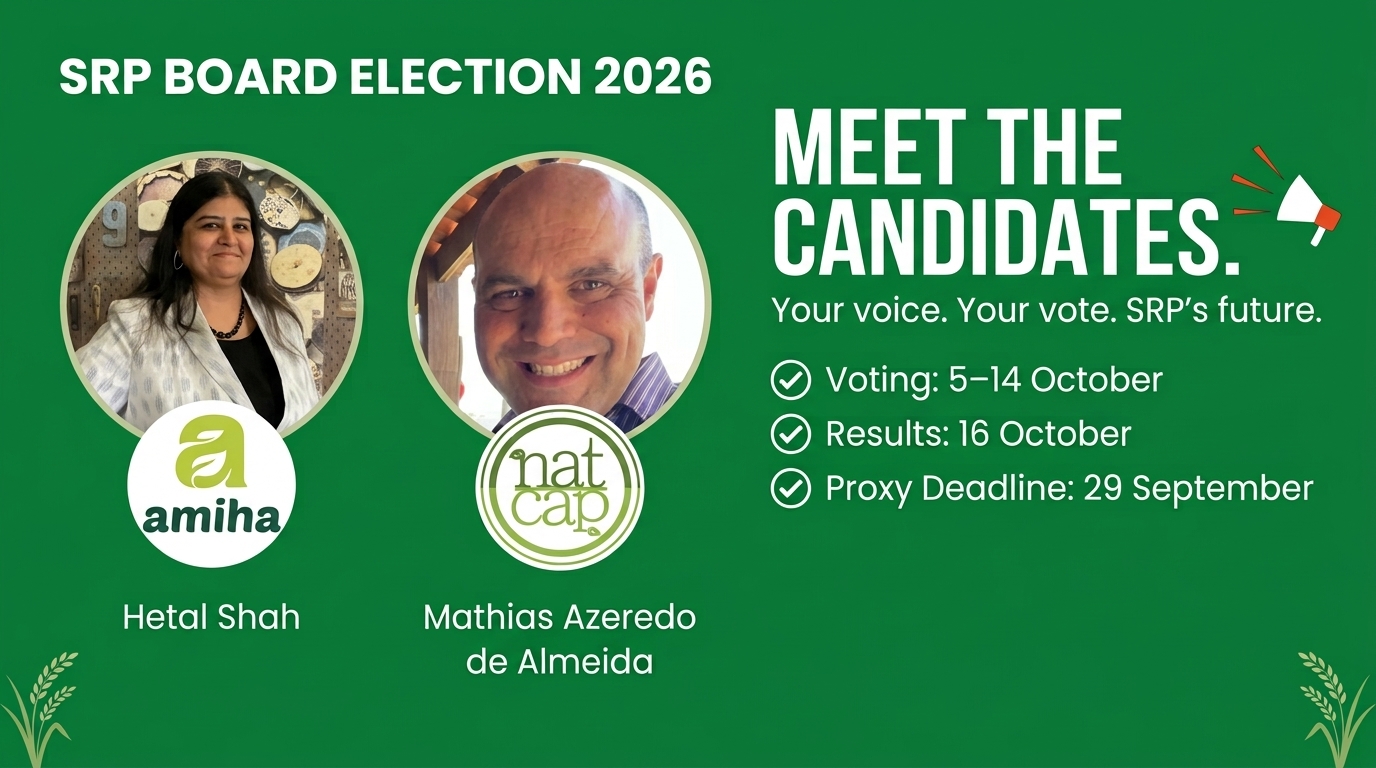
SRP Board Election: One Seat, Two Outstanding Candidates, Your Vote Shapes What Comes Next
The SRP Board sets the direction for our entire movement — and this year, one seat, two exceptional leaders, and every member's vote will decide who helps steward that future. This is your moment to
Read More
Meet the Speakers: From Pilot to Scale – Shaping the Future of L-CAM | SRP Webinar, 2 September 2026
For a solution to matter at scale, it has to survive contact with the real world — different geographies, different value chains, different buyers asking different questions. That's exactly the stage SRP's Low-Carbon Assurance Module
Read More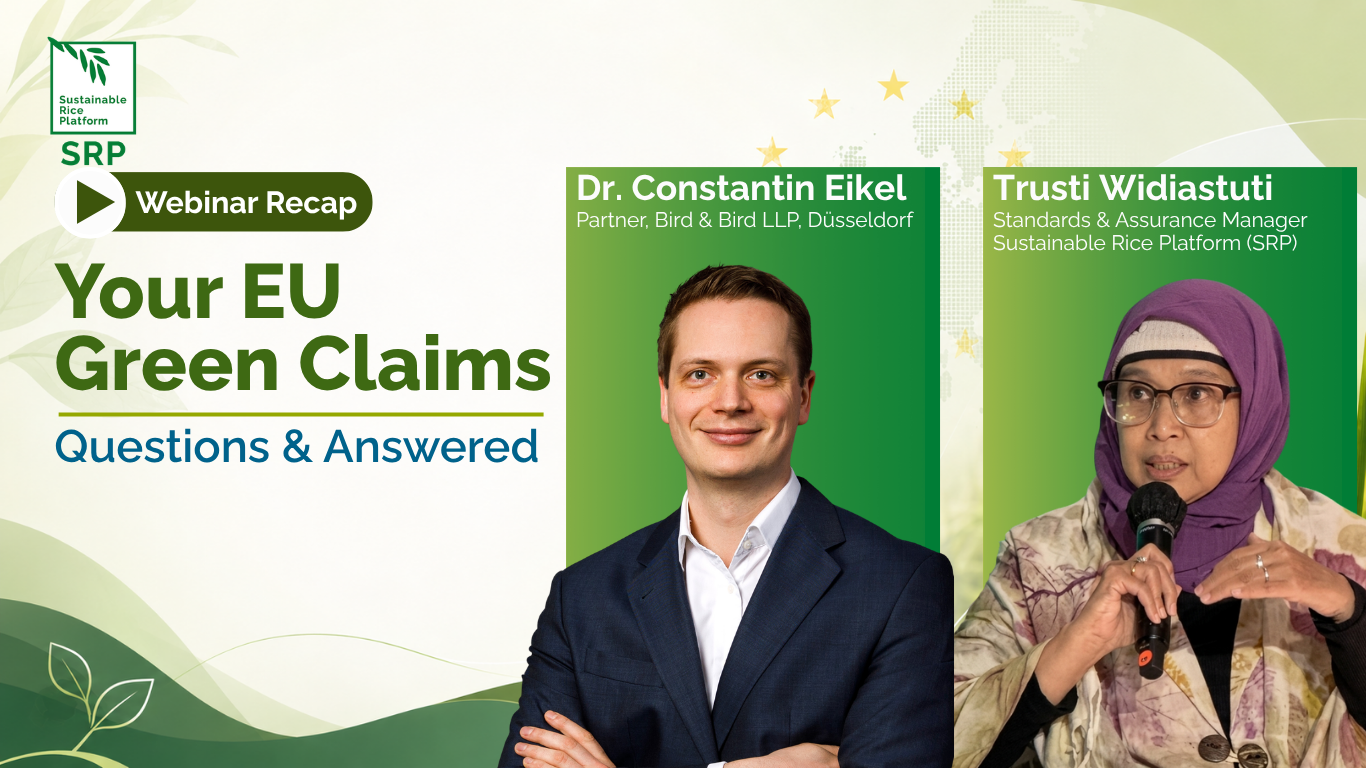
SRP Webinar Recap: Your EU Green Claims Questions, Answered
On 20 August 2026, the Sustainable Rice Platform (SRP) hosted a webinar on the EU Empowering Consumers for the Green Transition (EmpCo) Directive and what it means for sustainability claims in the rice sector. Moderated
Read More
Call for Nominations: SRP Board Election — One Seat, One Vote, Your Voice
Nominations open 20 August 2026 This is your moment to help steer the future of the Sustainable Rice Platform. One seat on the SRP Board — At Large — is opening up. Unlike seats reserved
Read More
How SRP prepared for the EU Empowering Consumers for the Green Transition Directive
The EU Empowering Consumers for the Green Transition (EmpCo) Directive (Directive (EU) 2024/825) introduces new requirements to improve the transparency and credibility of environmental claims and sustainability labels, helping consumers make better-informed purchasing decisions. SRP is committed
Read More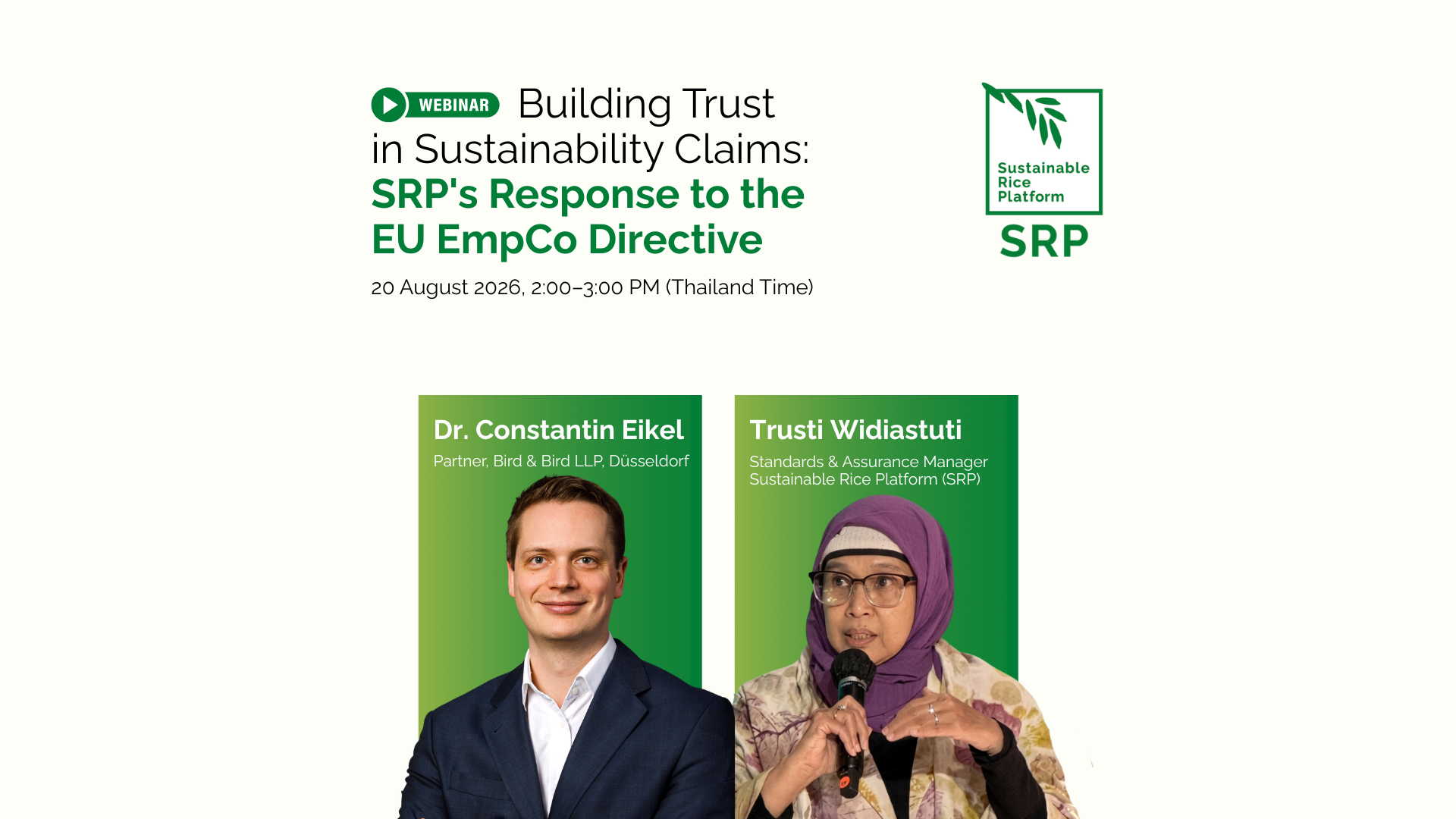
Meet the Speakers: Building Trust in Sustainability Claims: SRP’s Response to the EU EmpCo Directive | SRP Webinar, 20 August 2026
Starting 27 September 2026, the EU's EmpCo Directive comes into force — and it will fundamentally change how brands can talk about sustainability. Broad, unverified claims like "eco-friendly" or "green" won't hold up anymore unless
Read More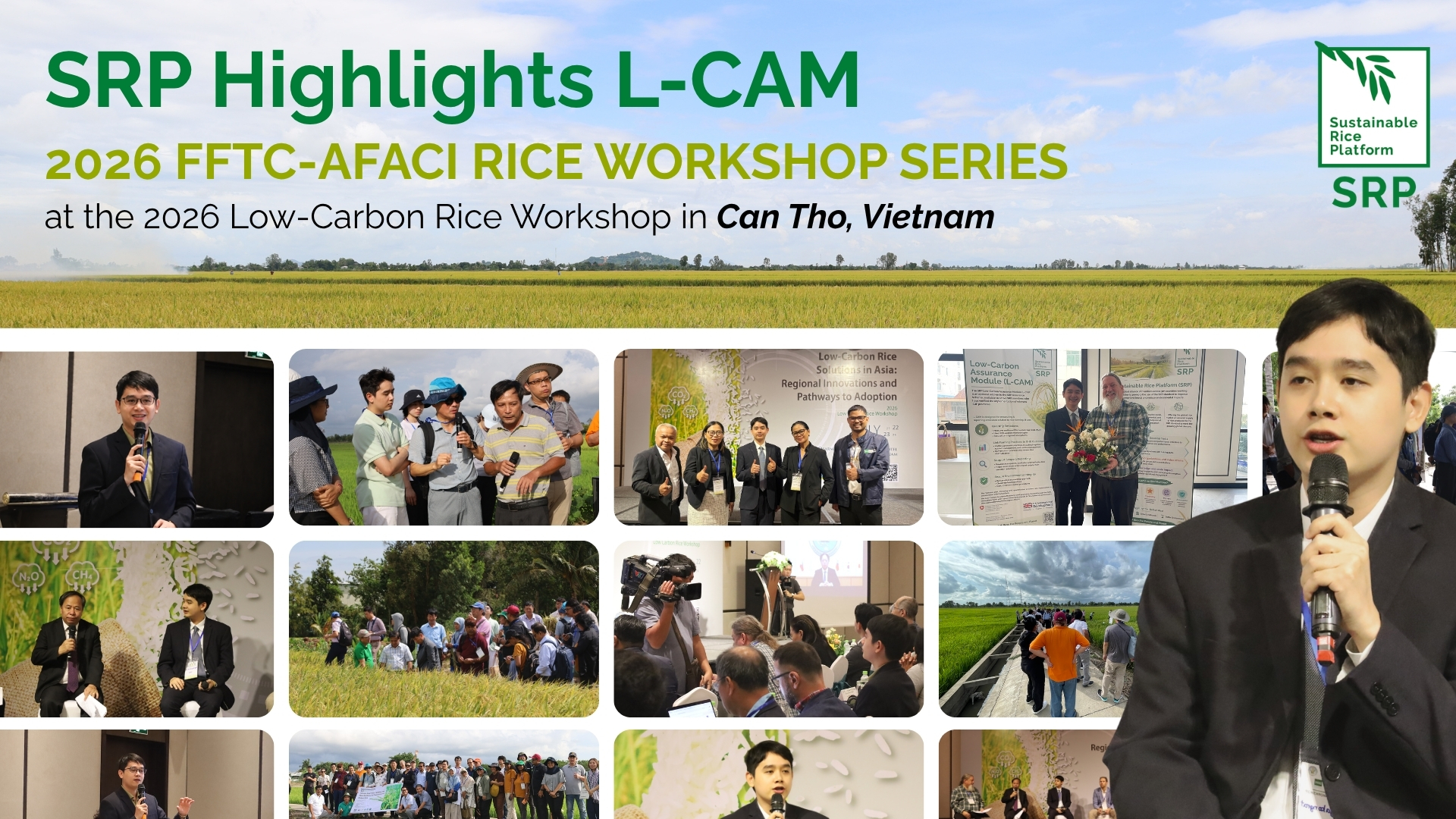
SRP Highlights L-CAM: 2026 FFTC-AFACI RICE WORKSHOP SERIES at the 2026 Low-Carbon Rice Workshop in Can Tho, Vietnam
From 22 to 24 July 2026, the rice world turned its attention to Can Tho City, Vietnam, for the FFTC workshop "Low-Carbon Rice Solutions in Asia." For the Sustainable Rice Platform (SRP), it was more than a
Read More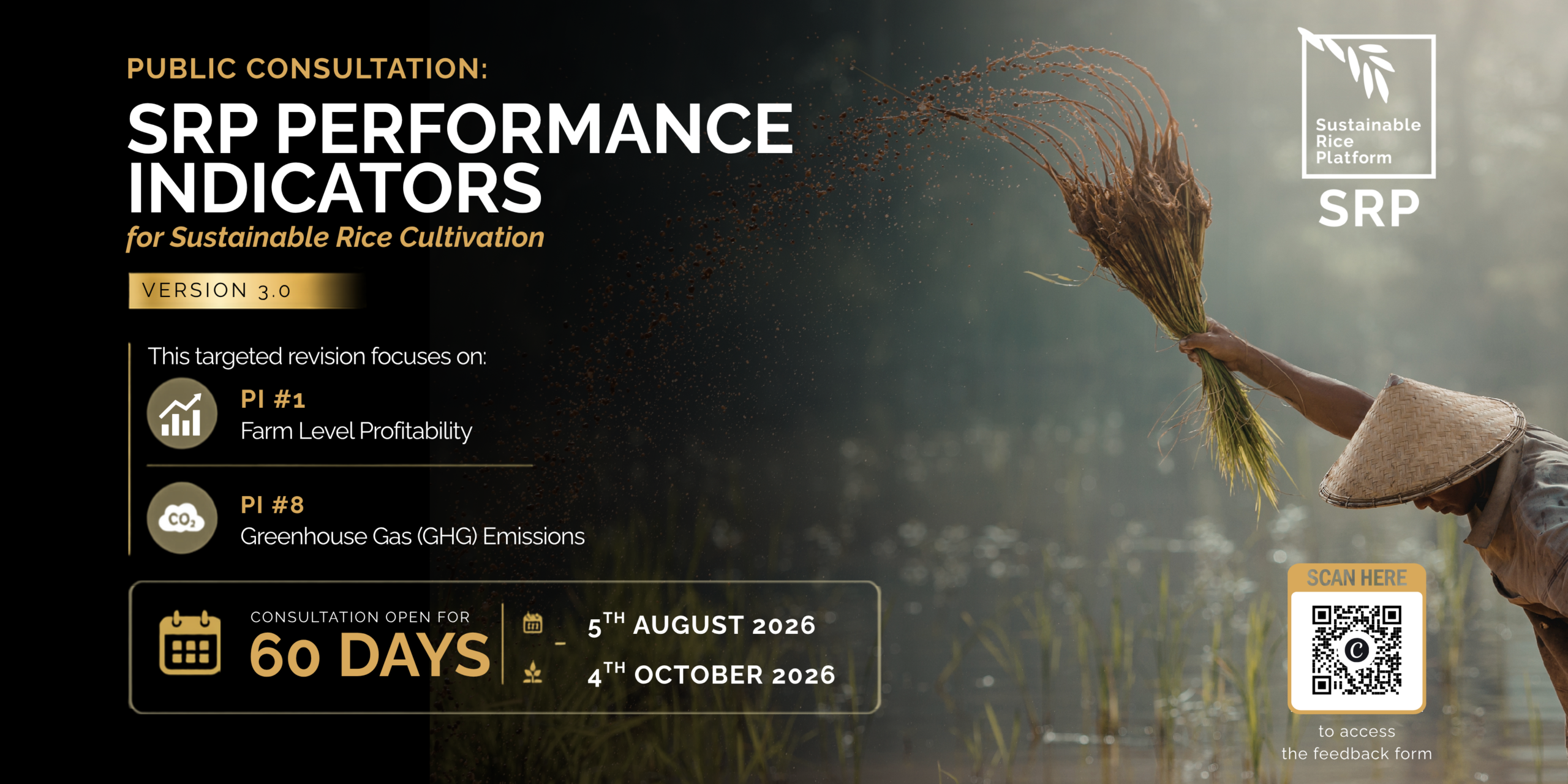
Public Consultation Open: Revision of SRP Performance Indicators for Sustainable Rice Cultivation
The Sustainable Rice Platform (SRP) invites stakeholders to participate in a 60-day public consultation on the proposed revision of the SRP Performance Indicators for Sustainable Rice Cultivation. The SRP Performance Indicators support the measurement of sustainability outcomes associated with rice cultivation and
Read More
Join Thai Webinar: Upgrade Thai Rice Production to meet an international market
As sustainability expectations continue to reshape global agricultural markets, the rice sector is entering a new era where transparency, traceability, and credible sustainability practices are becoming essential. To support stakeholders in navigating this transition, the
Read More
SRP Webinar, 20 August: Preparing for the EU EmpCo Directive
When "Sustainable" Has to Mean Something For years, sustainability claims have lived in a grey zone — a green leaf on a label, a promise of "eco-friendly," a badge nobody quite remembers verifying. Consumers wanted
Read More