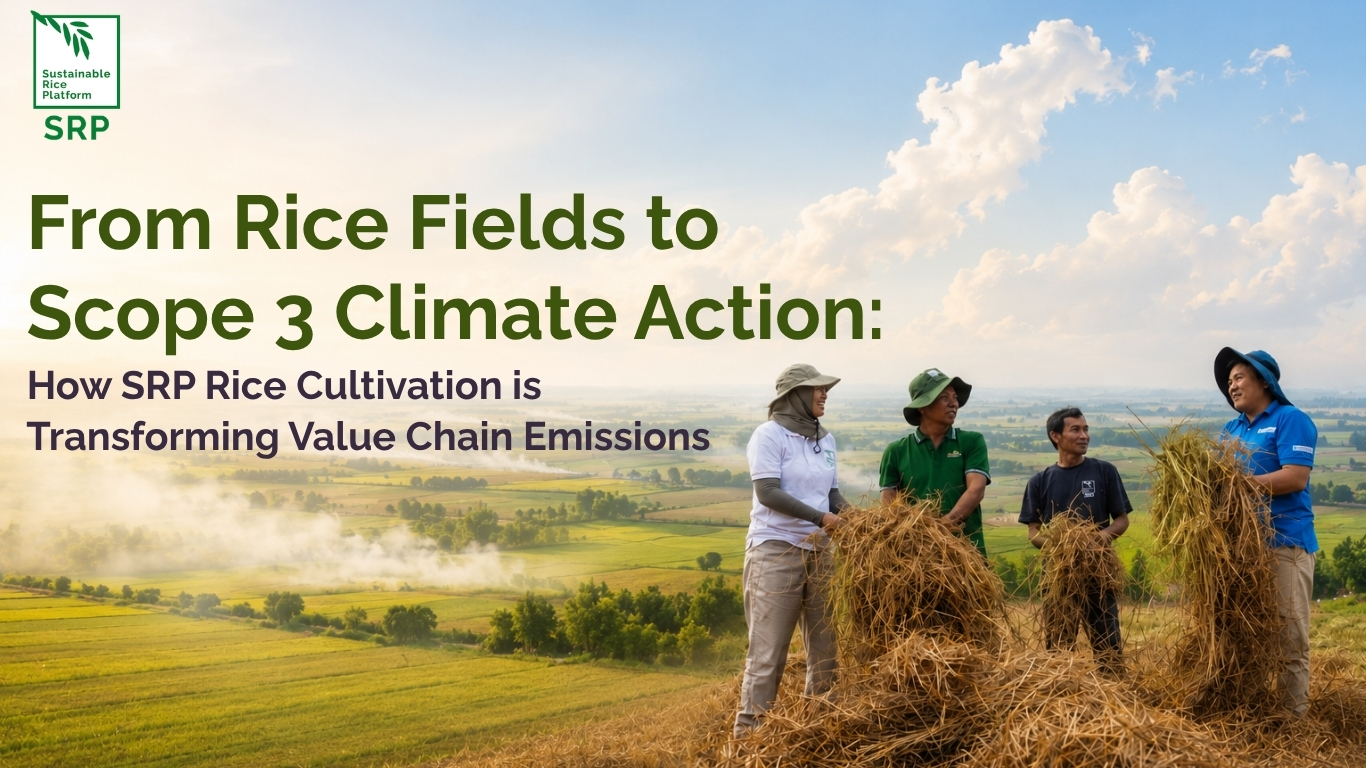
From Rice Fields to Scope 3 Climate Action: How SRP Rice Cultivation is Transforming Value Chain Emissions
Rice is the staple food for more than half of the world’s population, providing approximately 20% of global dietary energy and supporting the livelihoods of more than 150 million smallholder farmers, particularly across Asia. Yet while rice sustains billions of people, conventional rice production also presents one of agriculture’s greatest climate challenges.
Rice cultivation consumes nearly 40% of the world’s irrigation water and is responsible for an estimated 10–14% of global anthropogenic methane emissions. Methane, generated primarily from continuously flooded rice fields, is around 80 times more powerful than carbon dioxide over a 20-year period. In Southeast Asia—the world’s rice bowl—rice cultivation accounts for between 25% and 33% of regional methane emissions. Additional greenhouse gas emissions arise from excessive fertilizer use, agricultural burning, and poor management of rice straw and crop residues.
As climate change threatens to reduce global rice production by an estimated 15% by 2050, transforming the way rice is grown has become essential—not only to protect food security but also to decarbonize agricultural supply chains.
For food companies and retailers, emissions from rice cultivation fall largely within Scope 3, representing one of the most significant sources of emissions across their value chains. Reducing these emissions requires more than setting corporate climate targets—it requires enabling farmers to adopt climate-smart agricultural practices that lower emissions at the source.
The Sustainable Rice Platform (SRP) provides a globally recognized framework that helps make this transformation possible. Through the SRP Standard and Performance Indicators, farmers adopt sustainable practices that improve productivity while reducing environmental impacts. These include Alternate Wetting and Drying (AWD), optimized fertilizer management, integrated pest management, responsible rice straw management, and improved soil health practices. Together, these interventions reduce methane and nitrous oxide emissions, improve water-use efficiency, reduce agricultural burning, and strengthen farmers’ resilience to climate change—all while maintaining or improving rice yields and livelihoods.
Among these practices, Alternate Wetting and Drying (AWD) has emerged as one of the most effective methods for reducing methane emissions. Rather than keeping rice paddies continuously flooded, AWD allows fields to dry intermittently before re-irrigation. This simple change in water management interrupts methane formation, conserves water, lowers irrigation costs, and maintains healthy crop yields. Combined with better fertilizer application and responsible straw management, SRP farmers are significantly reducing the carbon footprint of rice production while improving farm profitability.
However, climate action requires more than good practices—it requires credible evidence that emissions reductions have been achieved. This is where the SRP Low-Carbon Assurance Module (L-CAM) plays a critical role. L-CAM translates sustainable farming practices into scientifically verified greenhouse gas outcomes, providing a practical and credible system for quantifying emissions reductions from rice cultivation. Farmers record field-level information such as water management, fertilizer application, residue management, and crop calendars. These data are combined with satellite observations to verify farming practices and flooding patterns, while greenhouse gas emissions are calculated using internationally recognized IPCC Tier 2 methodologies. The result is a transparent and scalable system that converts farm-level improvements into credible emissions data.
For companies, SRP L-CAM provides robust evidence that supports Scope 3 greenhouse gas accounting, climate disclosures, sustainability reporting, and supply chain decarbonization strategies. It gives businesses confidence that emissions reductions claimed within their rice supply chains are based on verified field practices rather than estimates alone. At the same time, it creates opportunities to reward farmers who adopt low-carbon production methods, helping to build more resilient and sustainable rice value chains.
Behind every verified emissions reduction is a farmer making better decisions.
In An Giang Province, Viet Nam, Lam Van Bac, an SRP farmer, has fundamentally changed the way he manages his fields after learning how everyday farming decisions influence greenhouse gas emissions.
“In the past, I managed water, pesticides and fertilizer by habit—following the methods I had always known, without paying attention to the emissions generated by my farming practices. Since implementing SRP, I farm more responsibly. I am now more environmentally conscious.”
Credit Photo: SRP
His experience reflects changes reported by other farmers participating in SRP programs where the practices outlined in the SRP Standard are increasingly incorporated into day-to-day farm management.
For fellow SRP farmer Tran Van Nguyen, one of the biggest changes came through adopting Alternate Wetting and Drying (AWD), an SRP-recommended water management practice that reduces methane emissions while saving water.
For fellow SRP farmer Tran Van Nguyen, one of the biggest changes came through adopting Alternate Wetting and Drying (AWD), an SRP-recommended water management practice that reduces methane emissions while saving water.
“I used to think keeping my rice field flooded all the time was the best approach, but it was harming my crop. Through my buyer, Blue Ocean, I learned about the SRP practice called Alternate Wetting and Drying (AWD). Instead of keeping the field continuously flooded, we maintain water in the field for only three to five days before allowing it to dry, then repeat the cycle.”
This simple change has reduced water use, lowered irrigation costs, reduced methane emissions, and maintained healthy yields—demonstrating that climate-smart agriculture can benefit both farmers and the environment.
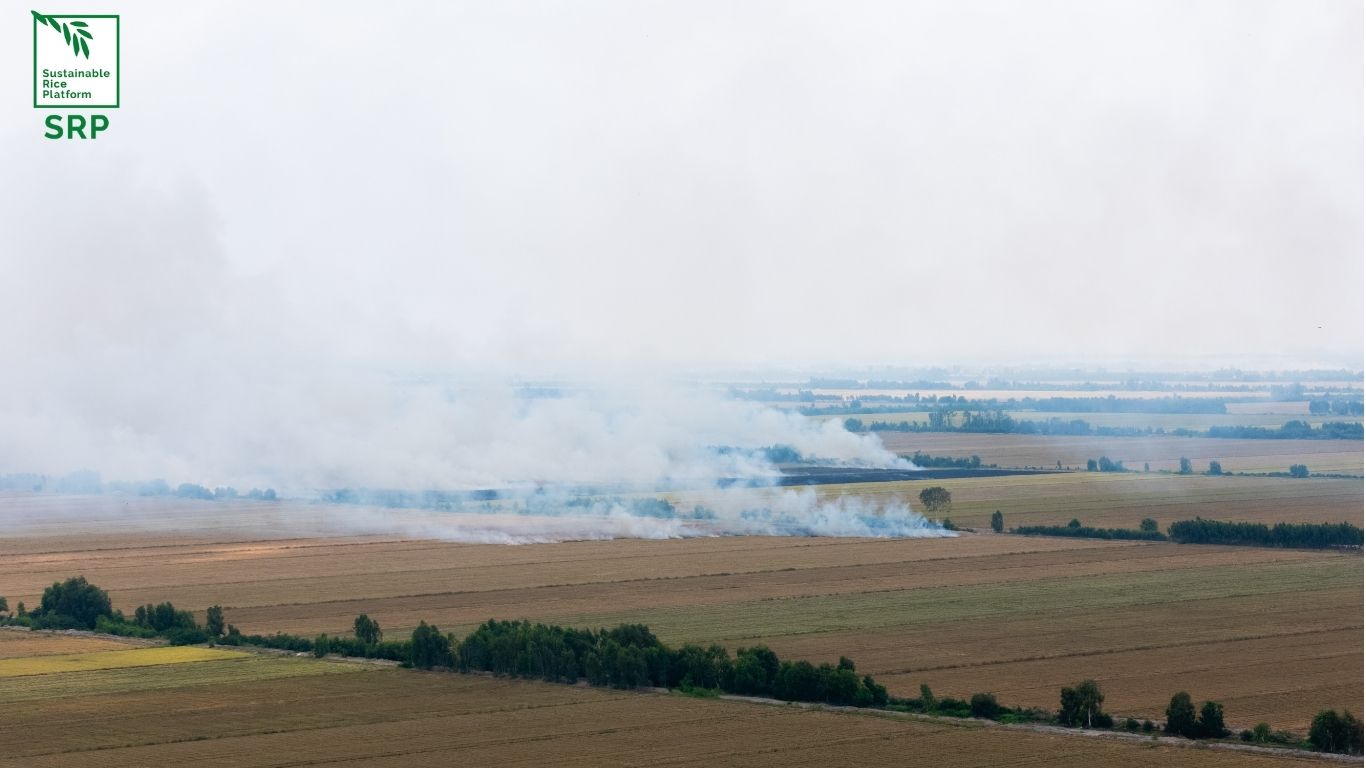
Rice cultivation under the SRP Standard involves more than water management. It also includes improving the way crop residues are managed after harvest. Across many rice-growing regions, rice straw has traditionally been burned in the field to quickly prepare land for the next crop. While convenient, open-field burning releases greenhouse gases and air pollutants, contributes to poor air quality, and wastes valuable organic matter that could instead enrich the soil.
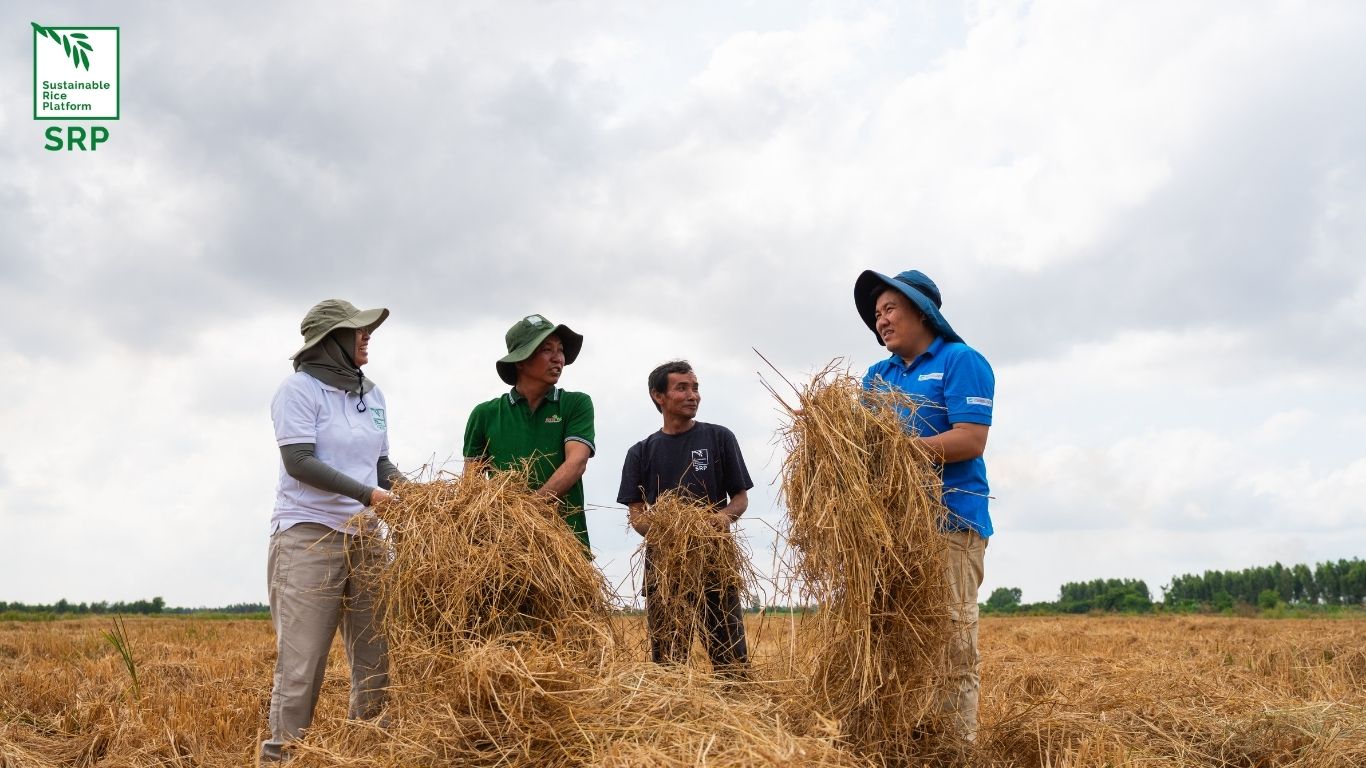
Through the SRP Standard, farmers are replacing this practice with improved rice straw management by incorporating straw back into the soil or composting it into organic fertilizer. This practice reduces emissions from agricultural burning, returns nutrients to the soil, improves soil health, and helps reduce dependence on synthetic fertilizers, contributing to lower greenhouse gas emissions across the rice value chain.
As Tran Van Dinh, an SRP farmer from An Giang, Viet Nam, explains:
“In the past, we burned rice straw. It caused a lot of air pollution and created smoke contamination. Now we don’t burn it anymore. We turn it into fertilizer.”
Credit Photo: SRP
What was once treated as agricultural waste has become a valuable resource. By transforming rice straw into organic fertilizer rather than burning it, farmers are improving soil fertility, reducing air pollution, enhancing soil carbon, and lowering the carbon footprint of rice production. Together with practices such as Alternate Wetting and Drying and optimized fertilizer management, sustainable residue management demonstrates how everyday decisions on the farm contribute directly to measurable Scope 3 emissions reductions throughout the rice supply chain.
These farmer-led improvements are the foundation of the SRP Low-Carbon Assurance Module (L-CAM), which translates climate-smart farming practices into scientifically verified greenhouse gas outcomes. By combining farmer-reported field data with satellite observations and internationally recognized IPCC Tier 2 methodologies, SRP L-CAM provides companies with credible, transparent evidence of emissions reductions within their rice supply chains. This enables businesses to strengthen Scope 3 greenhouse gas accounting, support climate disclosures, and demonstrate measurable progress toward supply chain decarbonization while creating incentives for farmers to continue adopting rice production practices aligned with the SRP Standard.
As more farmers adopt SRP practices and participate in L-CAM, the value of every verified hectare extends far beyond the farm. For food companies, emissions from rice cultivation represent a significant source of Scope 3 emissions—the indirect emissions generated throughout their supply chains. By transforming climate-smart farming practices into credible, scientifically verified emissions data, SRP L-CAM helps businesses measure, report, and reduce these emissions with confidence. In doing so, it bridges the gap between farmers’ actions in the field and corporate climate commitments, creating more transparent, resilient, and low-carbon rice value chains for the future.
Related Post
SRP Board Election: One Seat, Two Outstanding Candidates, Your Vote Shapes What Comes Next
The SRP Board sets the direction for our entire movement — and this year, one seat, two exceptional leaders, and every member's vote will decide who helps steward that future. This is your moment to
Read More
From Pilot to Scale: SRP Convenes Record Webinar on the Low Carbon Assurance Model
Nearly 300 registrants of this webinar, the Value Change Initiative and private-sector buyers to shape the pathway from LCAM's India and Vietnam pilots to sector-wide implementation BANGKOK, 2 September 2026 — The Sustainable Rice Platform (SRP) today convened one of
Read More
Meet the Speakers: From Pilot to Scale – Shaping the Future of L-CAM | SRP Webinar, 2 September 2026
For a solution to matter at scale, it has to survive contact with the real world — different geographies, different value chains, different buyers asking different questions. That's exactly the stage SRP's Low-Carbon Assurance Module
Read More
SRP Webinar Recap: Your EU Green Claims Questions, Answered
On 20 August 2026, the Sustainable Rice Platform (SRP) hosted a webinar on the EU Empowering Consumers for the Green Transition (EmpCo) Directive and what it means for sustainability claims in the rice sector. Moderated
Read More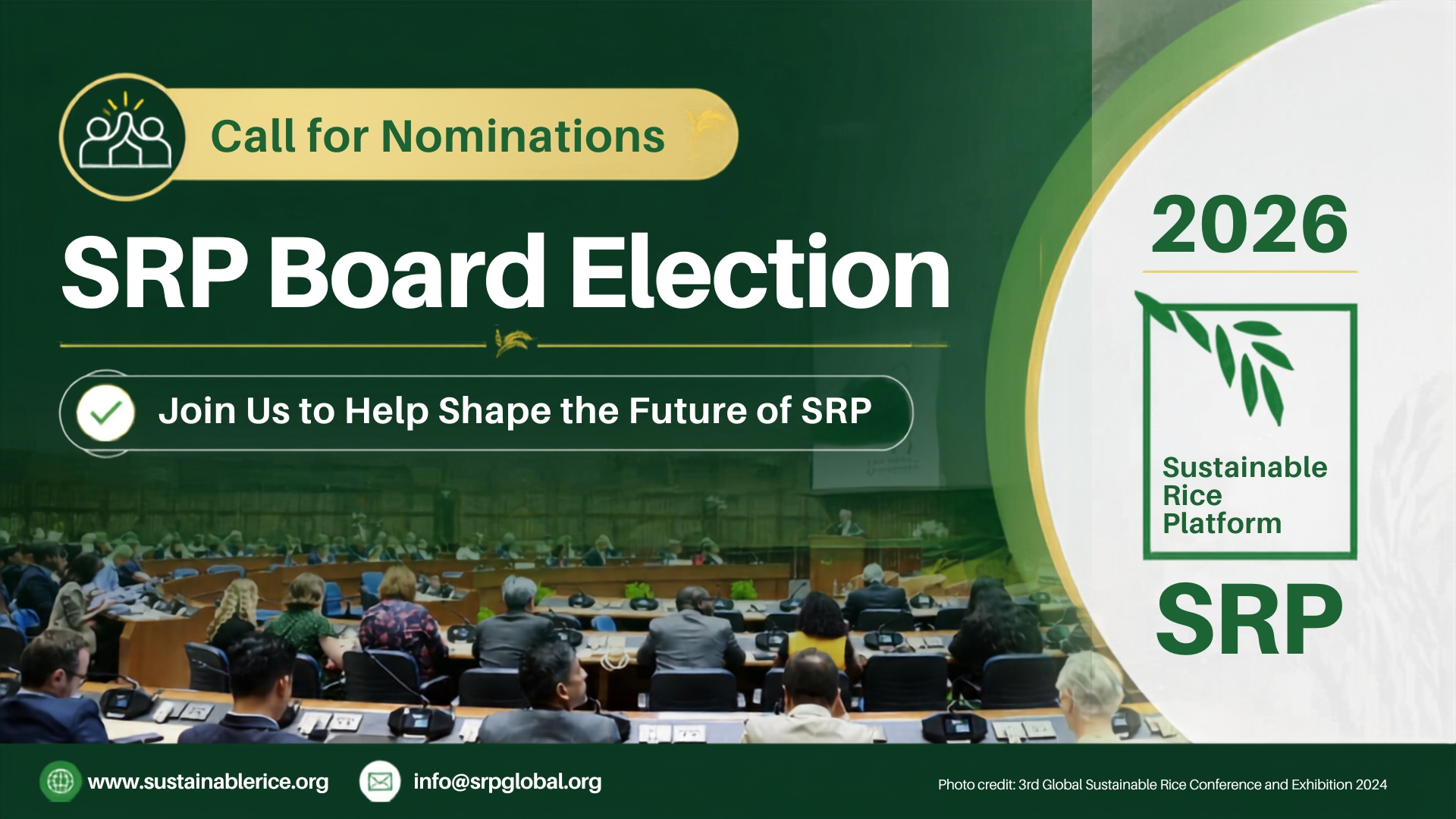
Call for Nominations: SRP Board Election — One Seat, One Vote, Your Voice
Nominations open 20 August 2026 This is your moment to help steer the future of the Sustainable Rice Platform. One seat on the SRP Board — At Large — is opening up. Unlike seats reserved
Read More
How SRP prepared for the EU Empowering Consumers for the Green Transition Directive
The EU Empowering Consumers for the Green Transition (EmpCo) Directive (Directive (EU) 2024/825) introduces new requirements to improve the transparency and credibility of environmental claims and sustainability labels, helping consumers make better-informed purchasing decisions. SRP is committed
Read More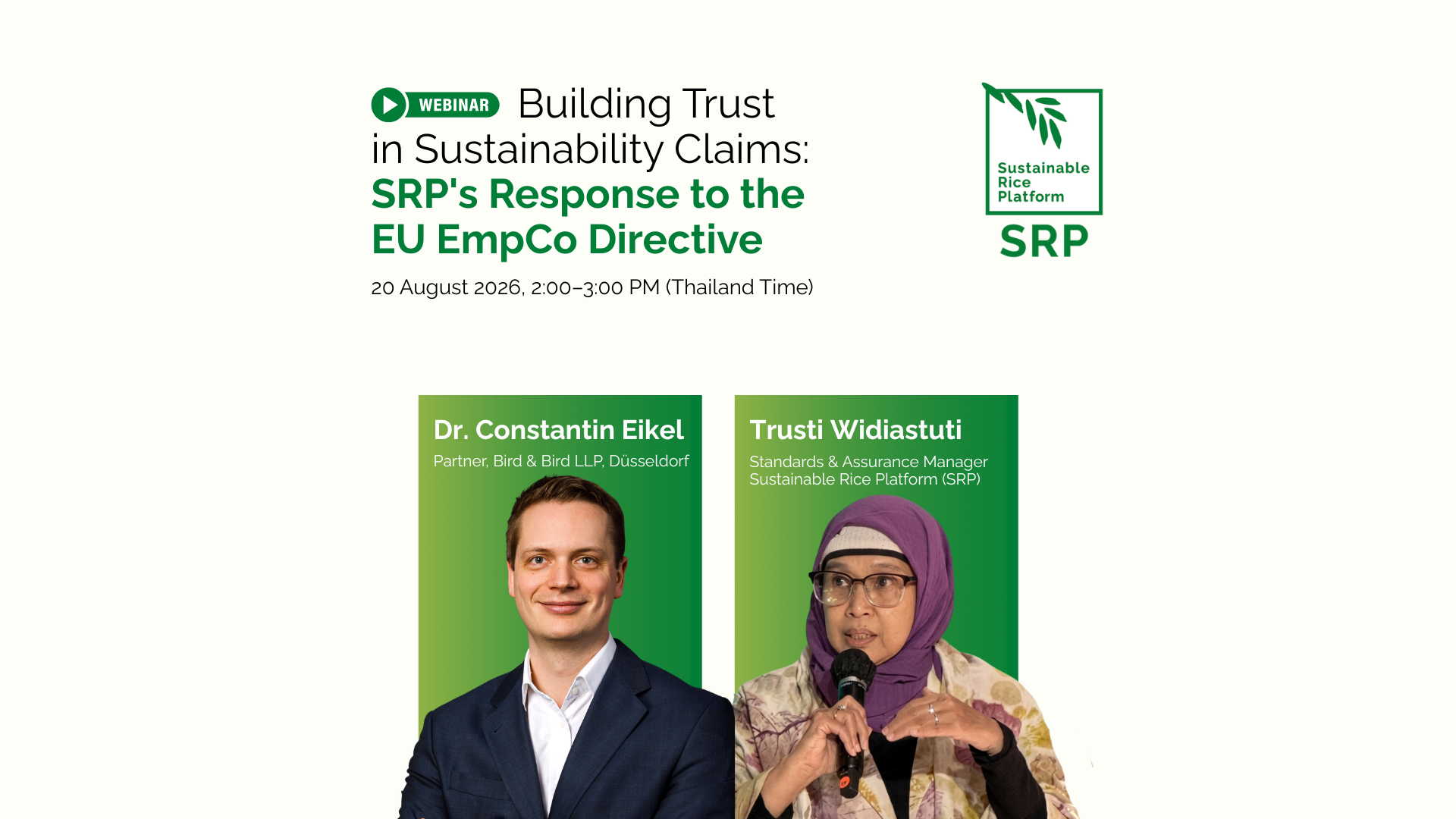
Meet the Speakers: Building Trust in Sustainability Claims: SRP’s Response to the EU EmpCo Directive | SRP Webinar, 20 August 2026
Starting 27 September 2026, the EU's EmpCo Directive comes into force — and it will fundamentally change how brands can talk about sustainability. Broad, unverified claims like "eco-friendly" or "green" won't hold up anymore unless
Read More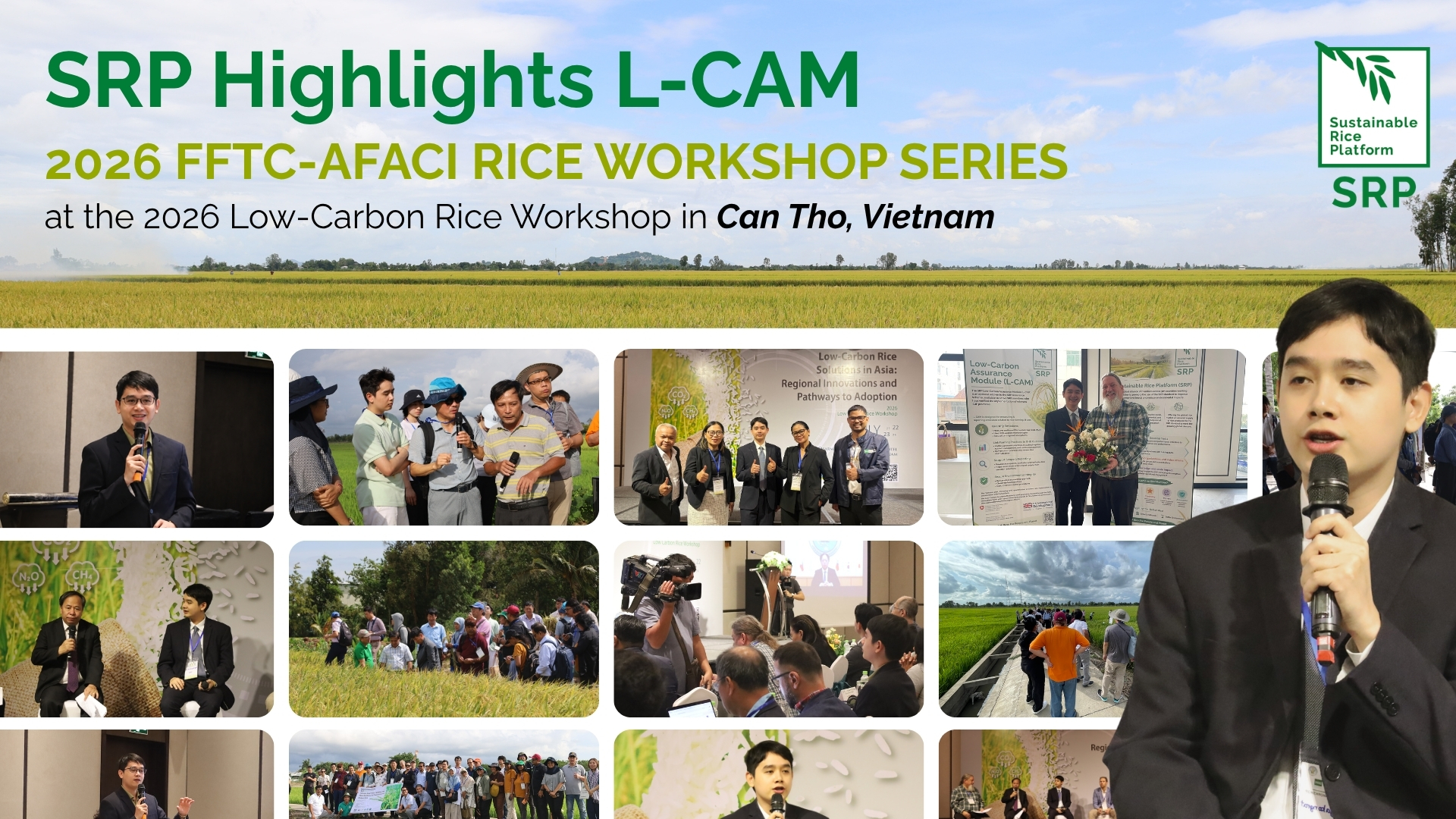
SRP Highlights L-CAM: 2026 FFTC-AFACI RICE WORKSHOP SERIES at the 2026 Low-Carbon Rice Workshop in Can Tho, Vietnam
From 22 to 24 July 2026, the rice world turned its attention to Can Tho City, Vietnam, for the FFTC workshop "Low-Carbon Rice Solutions in Asia." For the Sustainable Rice Platform (SRP), it was more than a
Read More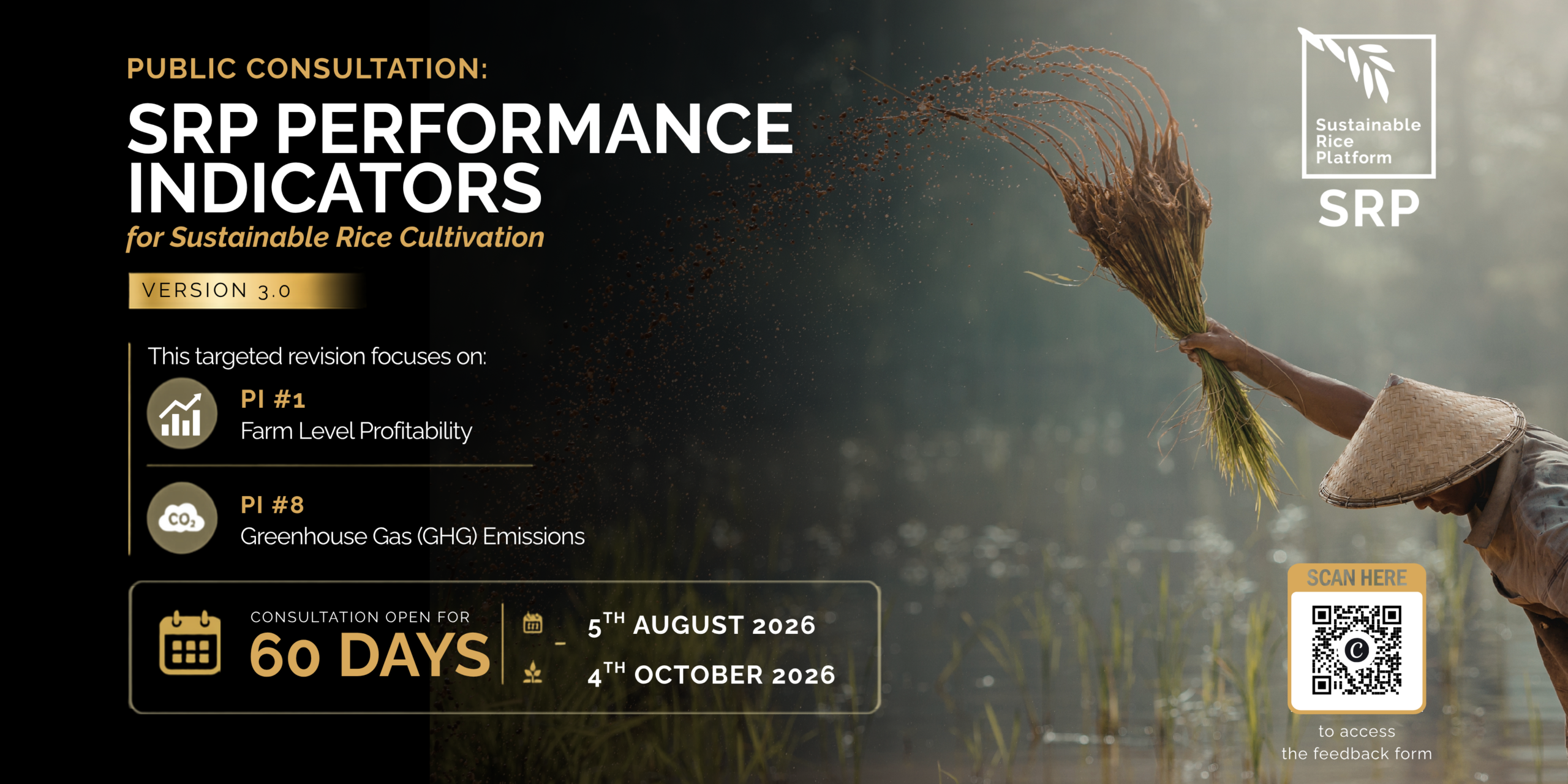
Public Consultation Open: Revision of SRP Performance Indicators for Sustainable Rice Cultivation
The Sustainable Rice Platform (SRP) invites stakeholders to participate in a 60-day public consultation on the proposed revision of the SRP Performance Indicators for Sustainable Rice Cultivation. The SRP Performance Indicators support the measurement of sustainability outcomes associated with rice cultivation and
Read More
Join Thai Webinar: Upgrade Thai Rice Production to meet an international market
As sustainability expectations continue to reshape global agricultural markets, the rice sector is entering a new era where transparency, traceability, and credible sustainability practices are becoming essential. To support stakeholders in navigating this transition, the
Read More