Insetting vs offsetting in rice
Companies are under pressure to reduce emissions fast — and to explain their approach in a way that stands up to scrutiny from auditors, customers, investors, and regulators.
Two terms come up constantly: insetting and offsetting. They’re related, but they’re not interchangeable.
A practical way to think about it:
- Offsetting is typically used to address residual Scope 1 and Scope 2 emissions via purchase of carbon credits.
- Insetting is typically used to drive Scope 3 supply chain decarbonisation
Rice carbon projects are an interesting example because unlike many other carbon crediting sectors, you typically find both types of programs. There are many offsetting projects designed to generate carbon credits as a result of lower emissions practices, but you also find many many food companies running insetting projects within their rice supply chains.
Rice methane reductions can be material — but the same tonne of reduction can’t credibly power both a Scope 3 reduction claim and a carbon credit claim. They provide different, and sometimes competing, accounting outcomes and claim rights.
Insetting (benefit stays within the supply chain)
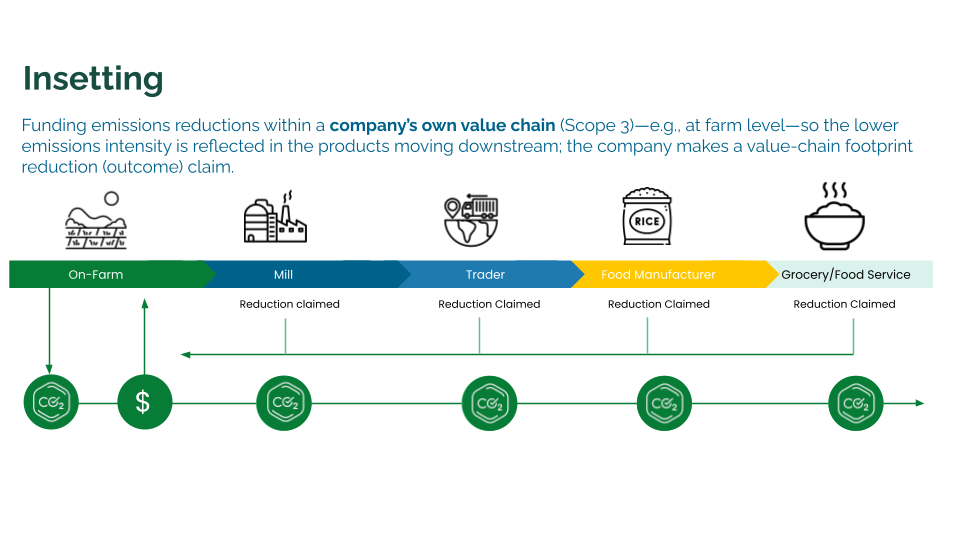
Insetting is when a company reduces emissions inside its own supply chain — for example, by supporting farmers in its sourcing regions to adopt practices that reduce methane.
- The carbon benefit is used to support supply chain decarbonisation.
- The “story” is: we reduced emissions associated with the products we buy / sell.
- Any eligible scope 3 reduction achieved on-farm can generally be claimed by all downstream actors for whom that rice represents a scope 3 input
- The benefit is not primarily treated as a tradable commodity.
Offsetting (benefit is traded out of the supply chain)
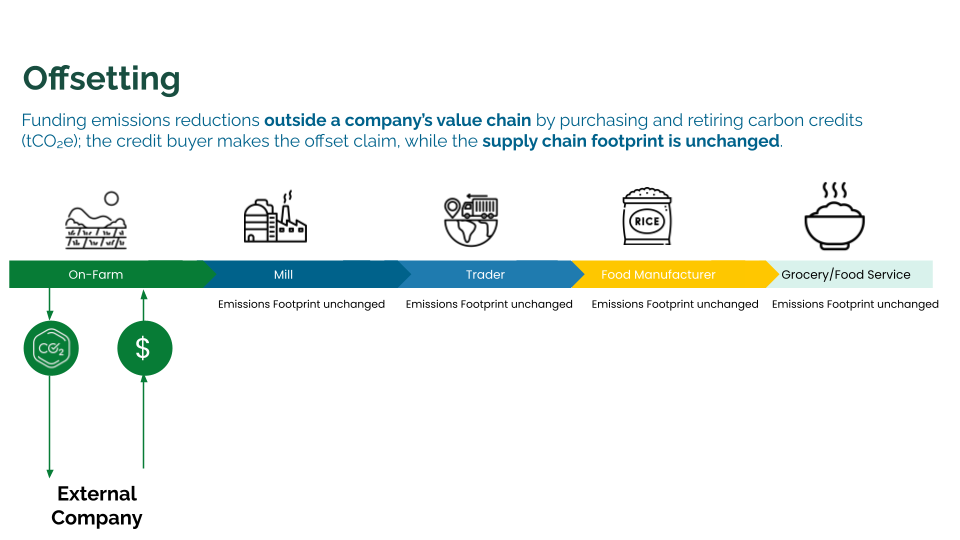
Offsetting is when a company compensates for emissions by purchasing carbon credits generated outside its supply chain, or by taking reductions generated in a supply chain and treating them as a separate tradable instrument.
- The carbon benefit is separated from the product and sold as a credit.
- The “story” is: we emitted X, and we purchased credits equal to X to compensate.
The accounting difference: one tonne can’t do two jobs
The same on-the-ground activity can sit underneath either approach.
But the accounting question that matters is: is the carbon benefit being used as an inset or an offset? It cannot be used as both simultaneously, and it is important that project owners prevent double claiming.
The risk of double claiming across offsets/insets would look something like this:
- A company buying rice claims a Scope 3 reduction from improved practices in its supply chain, while
- A different party buys/uses the carbon credit generated from the same reduction.
That’s the same tonne doing two jobs. Even when everyone is acting in good faith, this is exactly the kind of overlap that can trigger reputational risk, buyer scrutiny, and greenwashing allegations.
What claims can actually be made for rice grown in a carbon project?
What claims can be made by food companies, based on the way their rice was grown? A helpful way to distinguish between different types of claims is to separate practice-based claims from outcome-based claims.
1) Practice-based claims
Practice claims describe what farmers did, without claiming ownership of the quantified carbon outcome. These are generally compatible with a carbon project selling credits — because they don’t imply the buyer is also “using” the tonne. For instance, rice grown within carbon projects may be described by referring to the specific farming practices applied, including quantified outcomes such as reductions in water use or improvements in farmer income where these are measured and substantiated, rather than making a generic claim that the rice itself is “sustainable”. Rice in AWD projects, for example, can be described in terms of the specific water management practices applied and any measured outcomes associated with those practices. Provided that the claim is clear, specific and supported by appropriate evidence, these practices and outcomes can be communicated without implying ownership of the quantified GHG reduction.
2) Outcome-based claims
Outcome claims describe a quantified GHG result (e.g., methane reduced by X%, or Y tCO₂e avoided).
These are the claims that can easily become double claiming if the same reductions are also issued and sold as carbon credits.
Examples that require extra caution:
- “Our rice supply chain reduced methane emissions by X% versus baseline.”
- “This program delivered Y tCO₂e reductions.”
You can include outcome metrics, but treat them as sensitive and ensure they don’t read like a Scope 3 reduction claim if credits are being issued/sold.
How to avoid double claiming
In practice, supply chain participants that are participating in insetting programs must ensure the farmers/fields you’re using to support that claim are not also enrolled in a carbon market program that issues credits for the same reductions — especially when the claim is based on a transition in practices against a baseline.
Real life example of insetting: SRP’s Low Carbon Assurance Module
SRP’S low Carbon Assurance Module (L-CAM) is designed to provide an insetting benefit – so SRP members and buyers of SRP assured rice can claim a scope 3 reduction in annual reporting. That’s why in all L-CAM projects, there is typically both a rice production company and rice buying company. A great example is our recent work with Lotus Rice in Vietnam, who wanted to quantify the emissions footprint of their SRP assured farmers. The buyer for this project is Przedsiebiorstwo ROL-RYZ who will be able to use the emissions footprint in their reporting, and potentially claim a reduction against their historical procurement from non-SRP assured farmers.
One key risk that is managed in this process is the risk of double-claiming. For all producer groups going through SRP assurance, it is mandatory to declare if any farmers are participating in a carbon crediting program. Any farmers that have transferred their carbon rights to a carbon project developer are still eligible for the SRP assurance, but they are not eligible to be included in the quantification outcomes for the L-CAM report. For the purposes of the report, any land enrolled in a carbon project will be excluded or will have emissions footprint quantified in line with common practice within the region. Read more here L-CAM – Sustainable Rice Platform (SRP).
Real life example of offsetting: SRP – Flying Trade India – CarbonFarm
One of our members, Flying Trade India, has launched a carbon crediting project to generate carbon credits from improvements in water management practices aligned with the SRP standard. SRP has worked collaboratively with Flying Trade to support them as they embark on this project with CarbonFarm supporting as the MRV partner to quantify and monitor the GHG emission reductions.
In this case, Flying Trade aims to generate carbon credits, subject to the applicable carbon crediting and verification requirements. They will also be able to sell rice with the claim of SRP Assurance, including the SRP-Verified label, provided the applicable SRP requirements are met. However, where the emission reductions are issued and sold as carbon credits, offtakers of the rice should not also claim those same credited reductions towards their Scope 3 reductions, to avoid double claiming of the same GHG benefit.
Related Post
Call for Consultants: Technical Specialist – Rice Value Chain
Assignment Details PositionTechnical Specialist – Rice Value ChainContract TypeConsultancyLocationSoutheast Asia preferredFocus CountriesBangladesh and Cambodia, with potential activities in Viet NamApplication Deadline15 November 2026 1. Background The Sustainable Rice Platform (SRP) is seeking experienced consultants to
Read More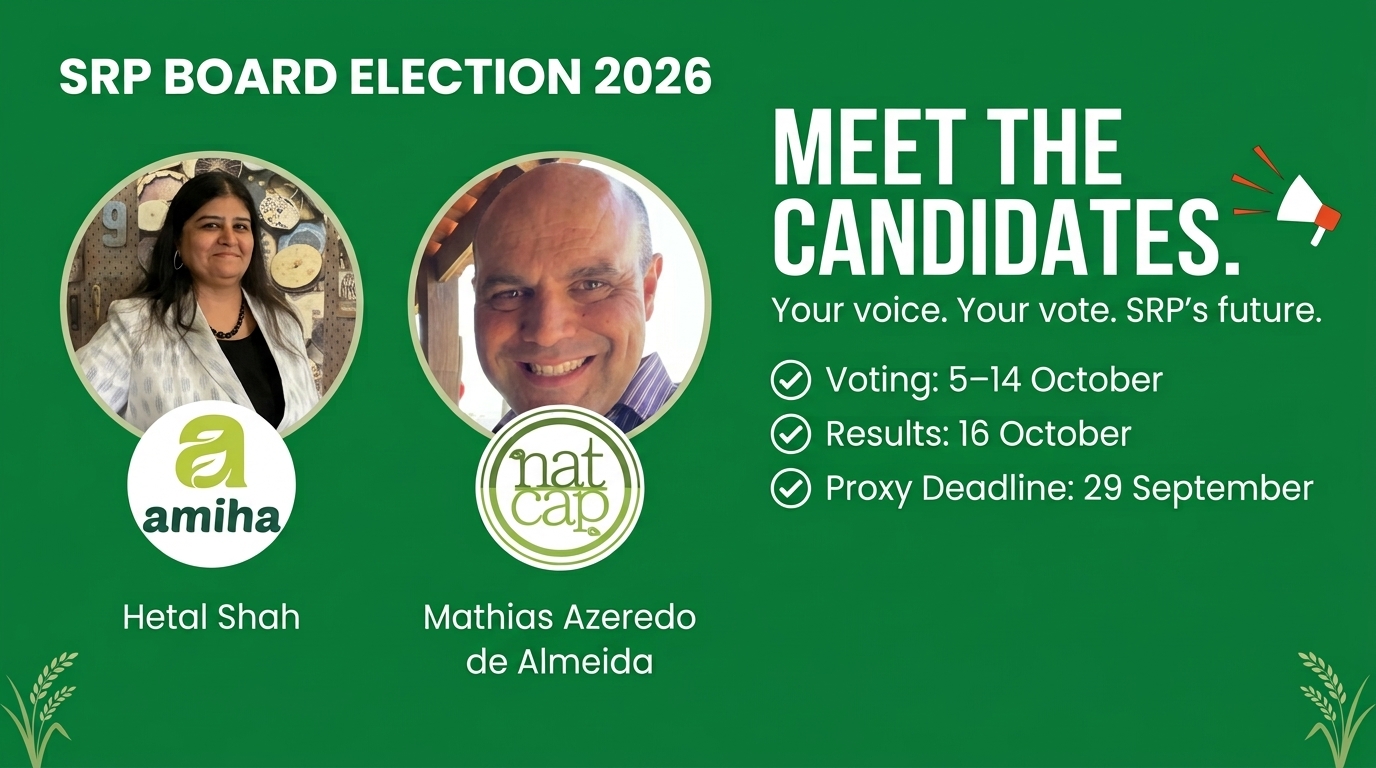
SRP Board Election: One Seat, Two Outstanding Candidates, Your Vote Shapes What Comes Next
The SRP Board sets the direction for our entire movement — and this year, one seat, two exceptional leaders, and every member's vote will decide who helps steward that future. This is your moment to
Read More
From Pilot to Scale: SRP Convenes Record Webinar on the Low Carbon Assurance Model
Nearly 300 registrants of this webinar, the Value Change Initiative and private-sector buyers to shape the pathway from LCAM's India and Vietnam pilots to sector-wide implementation BANGKOK, 2 September 2026 — The Sustainable Rice Platform (SRP) today convened one of
Read More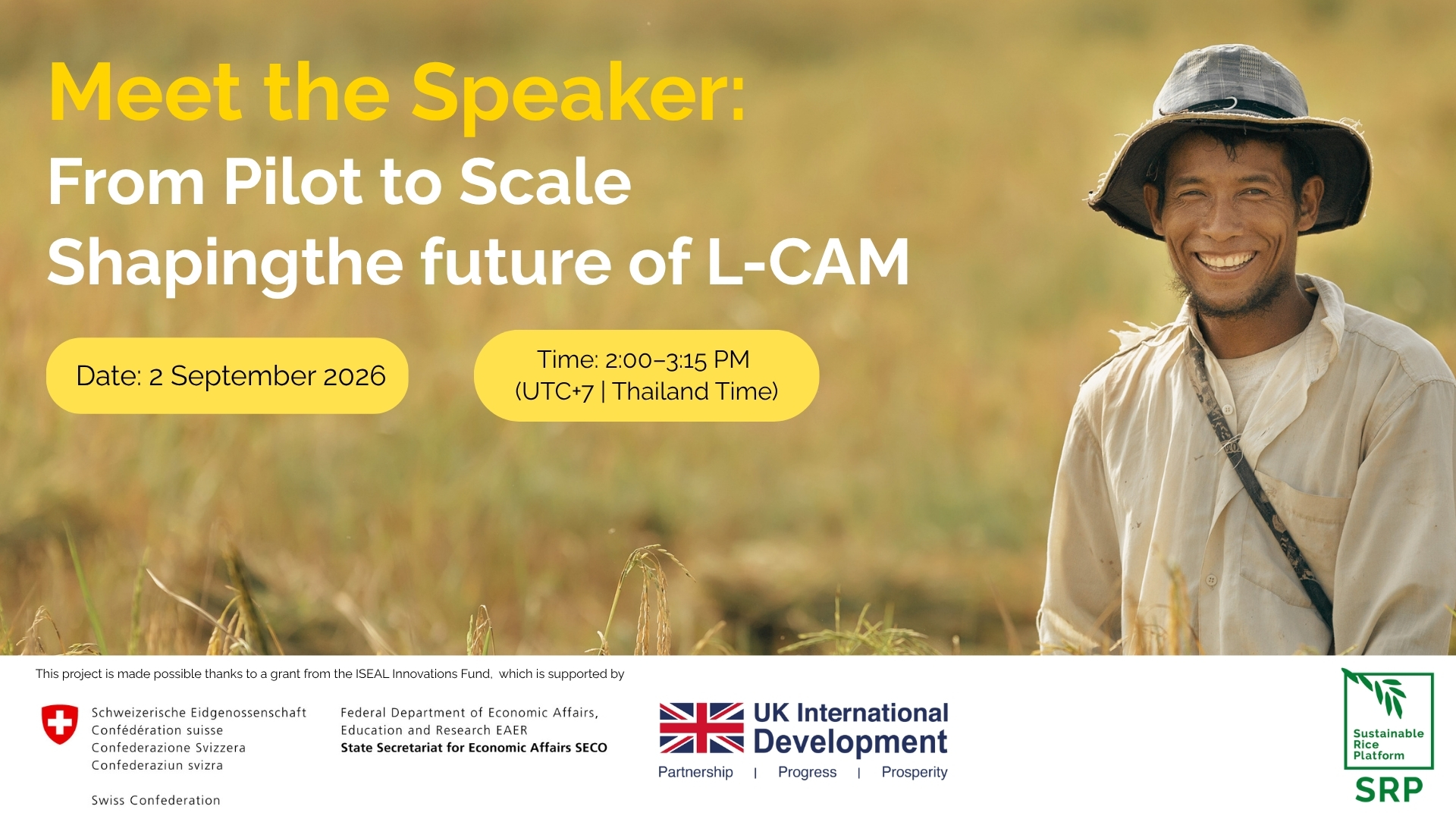
Meet the Speakers: From Pilot to Scale – Shaping the Future of L-CAM | SRP Webinar, 2 September 2026
For a solution to matter at scale, it has to survive contact with the real world — different geographies, different value chains, different buyers asking different questions. That's exactly the stage SRP's Low-Carbon Assurance Module
Read More
SRP Webinar Recap: Your EU Green Claims Questions, Answered
On 20 August 2026, the Sustainable Rice Platform (SRP) hosted a webinar on the EU Empowering Consumers for the Green Transition (EmpCo) Directive and what it means for sustainability claims in the rice sector. Moderated
Read More
Call for Nominations: SRP Board Election — One Seat, One Vote, Your Voice
Nominations open 20 August 2026 This is your moment to help steer the future of the Sustainable Rice Platform. One seat on the SRP Board — At Large — is opening up. Unlike seats reserved
Read More
How SRP prepared for the EU Empowering Consumers for the Green Transition Directive
The EU Empowering Consumers for the Green Transition (EmpCo) Directive (Directive (EU) 2024/825) introduces new requirements to improve the transparency and credibility of environmental claims and sustainability labels, helping consumers make better-informed purchasing decisions. SRP is committed
Read More
Meet the Speakers: Building Trust in Sustainability Claims: SRP’s Response to the EU EmpCo Directive | SRP Webinar, 20 August 2026
Starting 27 September 2026, the EU's EmpCo Directive comes into force — and it will fundamentally change how brands can talk about sustainability. Broad, unverified claims like "eco-friendly" or "green" won't hold up anymore unless
Read More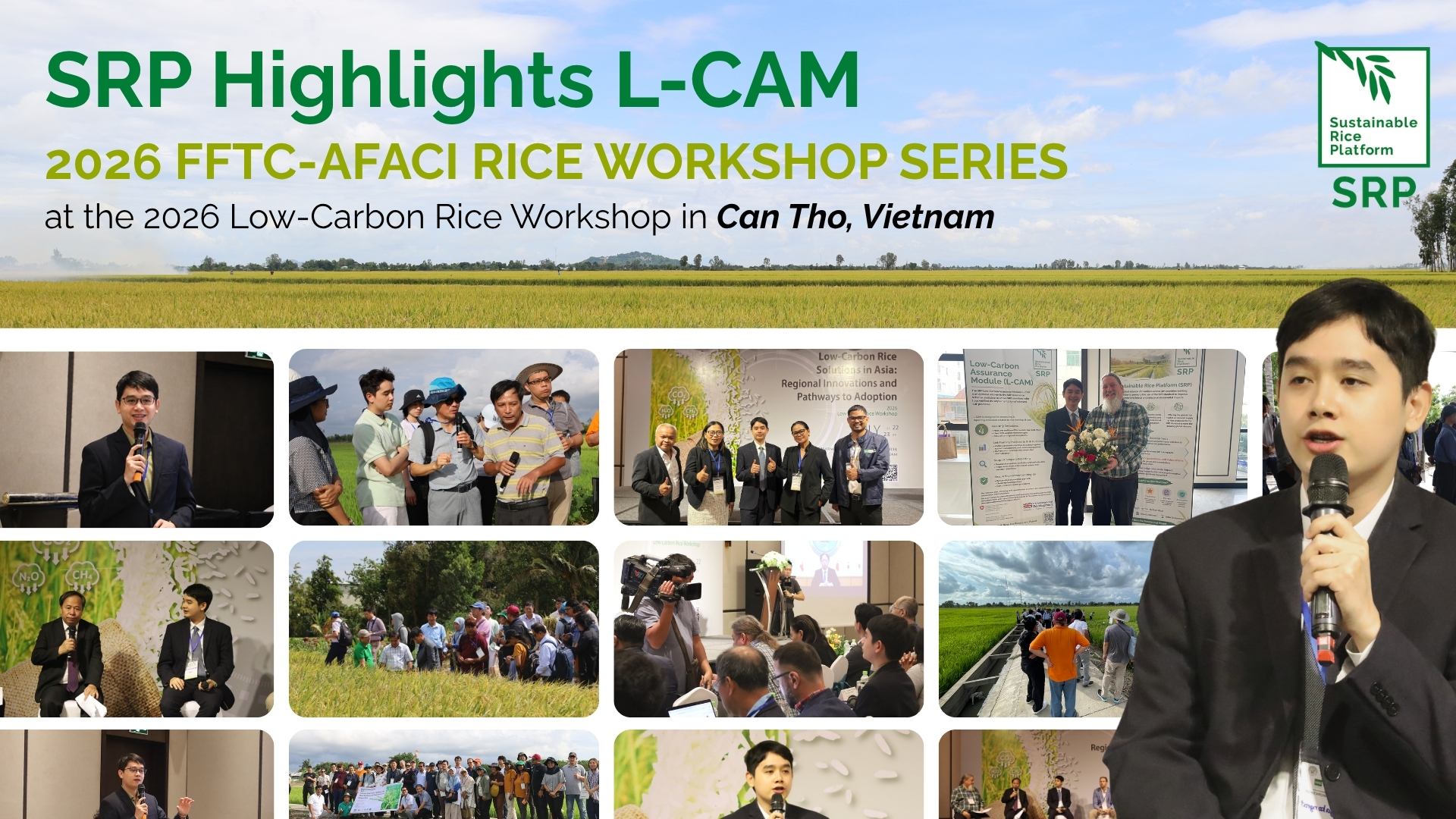
SRP Highlights L-CAM: 2026 FFTC-AFACI RICE WORKSHOP SERIES at the 2026 Low-Carbon Rice Workshop in Can Tho, Vietnam
From 22 to 24 July 2026, the rice world turned its attention to Can Tho City, Vietnam, for the FFTC workshop "Low-Carbon Rice Solutions in Asia." For the Sustainable Rice Platform (SRP), it was more than a
Read More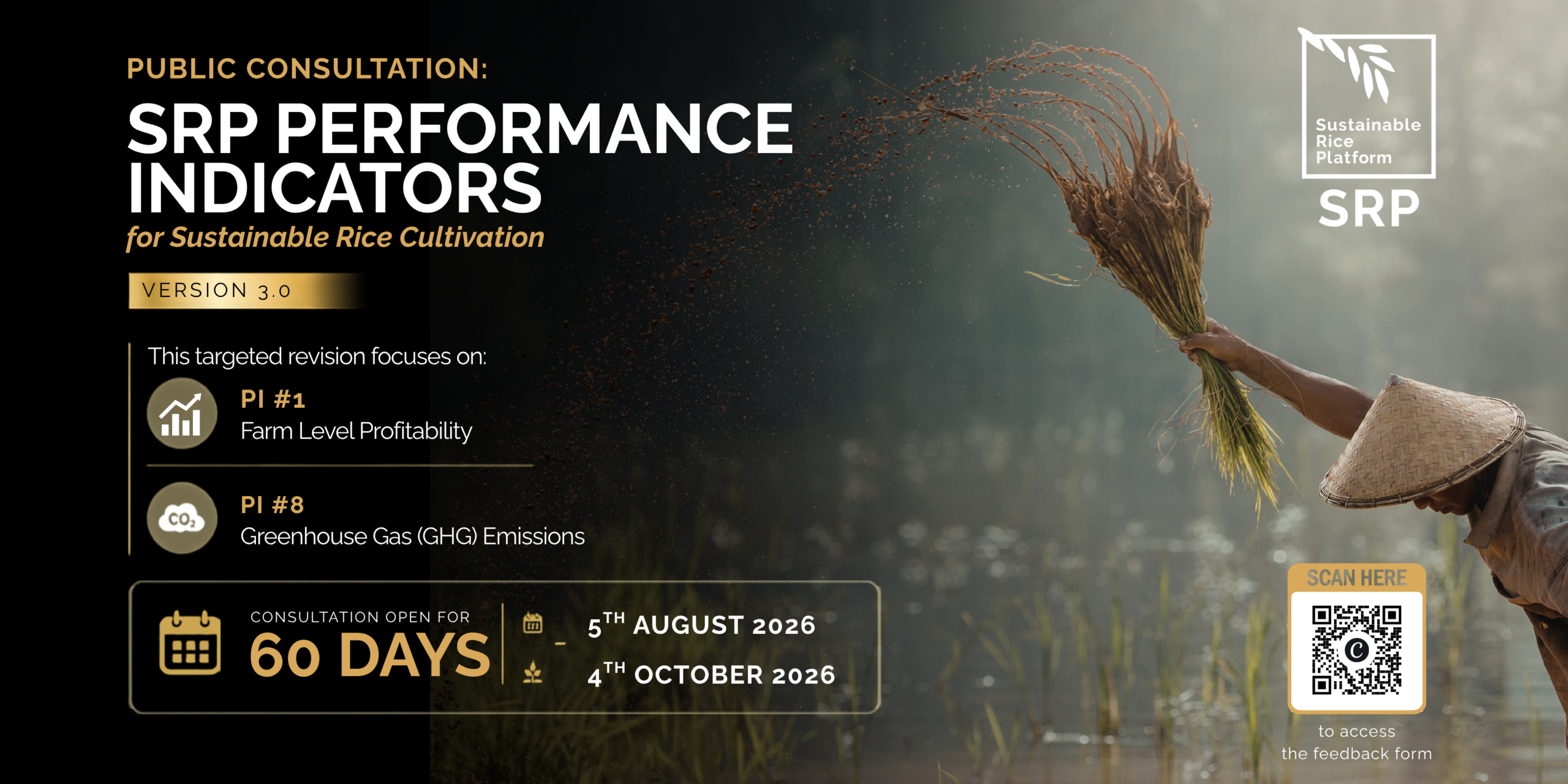
Public Consultation Open: Revision of SRP Performance Indicators for Sustainable Rice Cultivation
The Sustainable Rice Platform (SRP) invites stakeholders to participate in a 60-day public consultation on the proposed revision of the SRP Performance Indicators for Sustainable Rice Cultivation. The SRP Performance Indicators support the measurement of sustainability outcomes associated with rice cultivation and
Read More